There's an investment that pays you cash every quarter just for holding it: dividend investing. Alongside price appreciation, dividends are the other pillar of stock returns, and they're especially popular with long-term, stability-minded investors. Many analyses find that a large share of long-run total stock returns has come not from price gains but from dividends and their reinvestment.
What a dividend is
A dividend is a portion of a company's profit paid out to shareholders in cash or stock. Many US companies pay quarterly, and Korea is broadening from once-a-year dividends toward quarterly ones.
A company can either reinvest profits in the business or return them to shareholders through dividends and buybacks. Early-growth companies tend to prefer reinvestment, so they pay little or no dividend (many tech growth stocks fall in this camp), while more mature companies tend to grow their dividends over time. Dividend policy itself ends up being a clue to where a company sits in its life cycle.
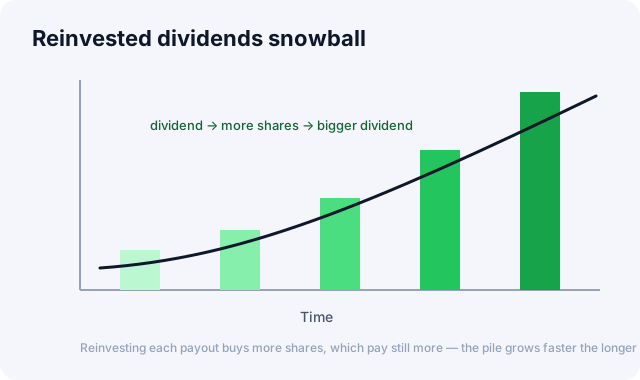
Reinvesting each payout buys more shares, which pay still more, so the pile grows faster the longer you hold.
Three numbers you must know
Dividend Yield is annual dividend divided by share price. It shows what percentage you'd receive buying at today's price, but yield rises when the price falls, so a high number isn't automatically good news. Payout Ratio is dividend divided by net income, or the percentage of profit paid out as dividends. Too high, say over 100%, means paying out more than the company earns, which is hard to sustain; too low can mean there's plenty of room to raise the dividend later. Dividend Growth Rate tracks how much the dividend has grown each year. A company that has steadily raised its dividend is signaling stable earnings and cash flow, and in the US there's even a category for it: "Dividend Aristocrats," companies that have raised dividends for 25 or more consecutive years.
Key dividend dates: understanding the ex-date
To receive a dividend, you need to know how long you must hold the stock. The record date is the day you must be on the shareholder register to receive the dividend. The ex-dividend date is the day buyers stop qualifying, and it's usually the business day before the record date. The payment date is simply when the dividend actually lands in your account.
Here's a misconception worth clearing up: on the ex-dividend date, the share price normally drops by about the dividend amount, and that's expected, not a bug. So the strategy of buying just before the dividend, grabbing it, and selling right after generally doesn't work, because the price falls by roughly what you collected.
The high-yield trap
A stock with an unusually high yield looks attractive, but watch out for the yield trap. The reason the yield is high may not be that the company is thriving. It may be that the price has crashed. A stock paying $2 a year yields 4% at $50, but if earnings deteriorate and the price halves to $25, the yield rises to 8%. The number looks more attractive, but it's actually a warning sign.
When earnings worsen, the dividend can be cut at any time, and then you lose the price and the dividend together. So don't look at yield alone. Weigh the sustainability of the dividend too, including the payout ratio, cash flow, and debt.
Pros and cons of dividend investing
On the plus side, cash flows in even when the market is flat or falling, and reinvesting it amplifies compounding. Dividend stocks also tend to be relatively less volatile, which helps from a risk-management standpoint.
On the downside, upside can be smaller than at high-growth companies, and dividends get taxed. When rates rise, high-yield stocks can also underperform as they lose the competition with bonds and deposits, which is why it's worth watching them alongside Treasury yields.
FAQ
Q. Can I build a whole portfolio from dividend stocks? Dividends are a good pillar, but they alone aren't enough diversification. Dividend stocks tend to cluster in certain sectors, like financials, utilities, and staples, so diversifying with growth stocks and bonds is safer.
Q. Individual dividend stocks or a dividend ETF? To reduce the risk of a single company cutting its dividend, a dividend ETF holding many payers is convenient. If you're confident in your own stock analysis and want to concentrate, individual names are an option too.
Q. What yield is "right"? There's no single answer. Too high can be a trap, too low offers weak income appeal. More important than the yield itself is whether the dividend is backed by earnings and has grown each year.
How to approach it
- Weigh sustainability over yield. A dividend that won't get cut matters more than a high one.
- Watch dividend growth. A record of annual increases is a powerful signal.
- Diversify. Don't concentrate in one name or sector; spread across multiple dividend sources.
- Reinvest. Reinvesting the dividends you receive dramatically changes long-run returns.
Indicators worth watching alongside
Dividend stocks are judged more soundly together with Treasury yields, the competing return, and a company's fundamentals like earnings and cash flow. The Global Market Dashboard shows individual companies' revenue and earnings trends alongside Treasury yields and market indicators. Frame the big picture of stock investing in Getting Started with Global Markets.
Primary source: Dividend, SEC investor education
This article is for informational purposes only and is not investment advice.