What investors who last share is not being right often, but not losing big. Behind every flashy return story are the hidden stories of people who left the market after a large loss. That's why you settle risk management before chasing returns. Risk management isn't a technique for giving up gains. It's the technique that keeps you in the game.
Why managing losses comes first
Losses are not symmetric with gains. This is the starting point of all risk management.
| Loss | Gain needed to recover |
|---|---|
| −10% | +11% |
| −25% | +33% |
| −50% | +100% |
| −80% | +400% |
To recover from −50% you need +100%. The bigger the loss, the exponentially harder the climb back. One large loss can erase all the gains you've stacked up, which is why avoiding catastrophic losses is the core of long-run returns. Warren Buffett's line, "Rule No. 1: never lose money. Rule No. 2: never forget Rule No. 1," isn't a joke. It's pointing at this math.
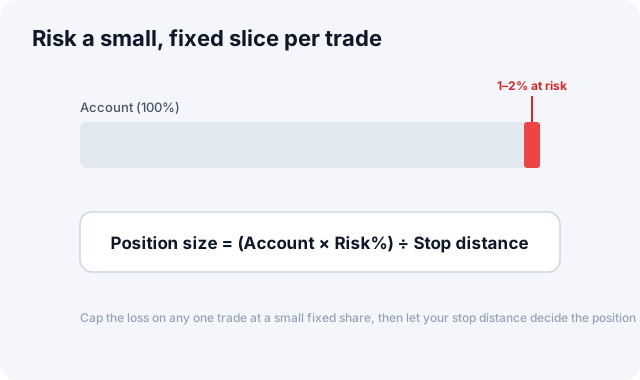
Cap the loss on any one trade at a small fixed share, then let your stop distance decide the position size.
Diversification
Not piling into one stock, one asset, or one country is the most basic shield you have. Mixing assets that move differently, meaning low correlation, means one can collapse while another holds, which lowers overall volatility. The key word is character, not count. Owning 20 stocks in the same sector isn't diversification. Real diversification mixes assets that react differently in a crisis: stocks, bonds, commodities, cash. The how of it is covered in diversification and asset allocation.
Position sizing
How much to buy matters as much as what to buy. In fact, long-run results are often decided more by sizing than by stock picking.
Don't put too large a share of your assets into one name; a personal cap of 10 to 20% per position is a reasonable rule of thumb. Cap the size of any one bet too, so a single failure isn't fatal to the whole portfolio. A common rule is to never risk more than 1 to 2% of total capital on a single trade. And hold smaller positions in more volatile assets, since for the same dollar amount, double the volatility means double the risk.
For example, with $10,000 and a rule of 2% max loss per trade, or $200, you can work the size backwards: up to $2,000 in a name with a 10% stop, or up to $1,000 in a name with a 20% stop.
Stops and rules
A stop cuts the loss at a pre-set line to keep it from snowballing into something bigger. The key is to set that line by rule, not emotion. Before buying, decide how much and why you'll tolerate a loss, together with what condition makes you sell. Decisions made mid-loss are almost always bad ones.
Stops that are too tight, though, get triggered by ordinary noise and can hurt you. Set them with room, matched to the name's normal volatility. Just as important as stops are take-profit and rebalancing rules. Trimming an asset that has grown too large, to bring its weight back down, is also risk management.
Understanding volatility
Volatility is just one measure of risk, and bigger isn't automatically bad. A volatile asset can be the source of bigger gains. What matters is knowing the level you can stomach and building the portfolio within it. Volatility you can't handle leads to the selling-at-the-bottom mistake, which is the most expensive one there is. Gauge market-wide volatility with the VIX and sentiment with the Fear & Greed Index.
FAQ
Q. Doesn't heavy diversification cut my returns? Versus extreme concentration, it can cap the upside. But the point of diversification isn't maximum return. It's avoiding a knockout blow. Because losses are asymmetric, avoiding big drawdowns leads to higher compound returns over time, which ties directly into compounding.
Q. What percentage should my stop be? There's no single answer. It depends on the name's volatility, your time horizon, and your max tolerable loss per trade. A 5% stop on a volatile name gets shaken out by noise. It's more consistent to work backwards from your max loss per trade than to pick a fixed percentage.
Q. Do long-term investors need risk management too? Even more so. The biggest enemy of long-term investing is selling because you can't stand a crash. Tolerable sizing and diversification are what let you hold through one.
How to apply it
- Use only money you can afford to lose. Don't put living expenses or short-term needs into risk assets.
- Set sizing rules in advance. Put per-name and per-asset-class caps, and a per-trade loss limit, into actual numbers.
- Plan scenarios ahead of time. Decide what you'll do if a position falls a certain amount, before it happens, to reduce emotion in the moment.
- Review and rebalance regularly. Each quarter or half-year, check whether weights have drifted from your rules.
Indicators worth watching alongside
To gauge market-wide risk, the VIX, the Fear & Greed Index, and financial-stress measures all help. On the Global Market Dashboard, check them on one screen to judge whether it's time to take risk down. Frame the whole of investing first in Getting Started with Global Markets.
Primary source: What is risk, SEC investor education
This article is for informational purposes only and is not investment advice.