The most powerful force in investing isn't flashy stock-picking. It's compound interest, and the time for it to work. The probably apocryphal line attributing "the eighth wonder of the world" to Einstein keeps getting repeated for a reason: the longer the horizon, the more compounding overwhelms our intuition. Our minds think in straight lines, but compounding grows exponentially.
What compounding is
Simple interest accrues only on the principal. $1,000 at 10% a year earns exactly $100 each year, so $1,000 grows to $2,000 over 10 years. Compound interest is interest on interest. Year one earns $100. Year two earns 10% of $1,100, or $110. Year three earns 10% of $1,210, or $121, and the rate of growth itself keeps speeding up. The same $1,000 at 10% over 10 years becomes about $2,590, which is $590 more than simple interest.
The key is to reinvest the gains so the principal keeps growing. Compounding only works when you roll dividends and interest back in rather than spending them. For stocks that means reinvesting dividends; for funds, it means choosing the accumulating share class instead of the distributing one.
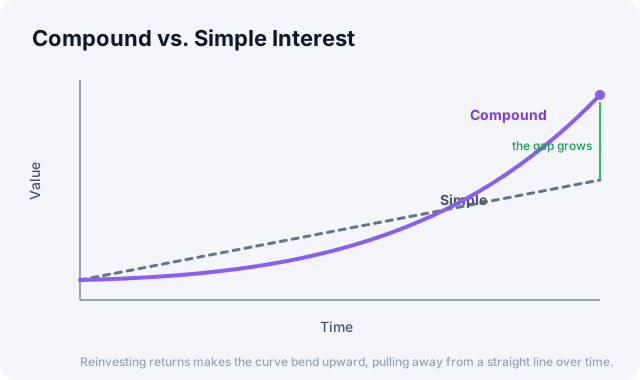
Simple interest grows in a straight line, while compounding bends upward over time, widening the gap.
The Rule of 72
The time it takes to double your money is roughly 72 divided by the annual return in percent. At 6% a year that's about 12 years, at 8% about 9 years, and at 10% about 7.2 years.
It works in reverse too. If your goal is to double your money in 10 years, you need a return of about 72 divided by 10, or roughly 7.2%. A slightly higher return compounds into an exponentially wider gap the longer you wait.
Time is the most powerful variable
In compounding, the biggest difference often comes from time, not the rate of return. Here's the classic example. Investor A puts a fixed amount away every year from age 25 to 35, ten years total, then never adds another cent and just leaves it invested. Investor B puts away the same amount every year from age 35 to 65, thirty years total.
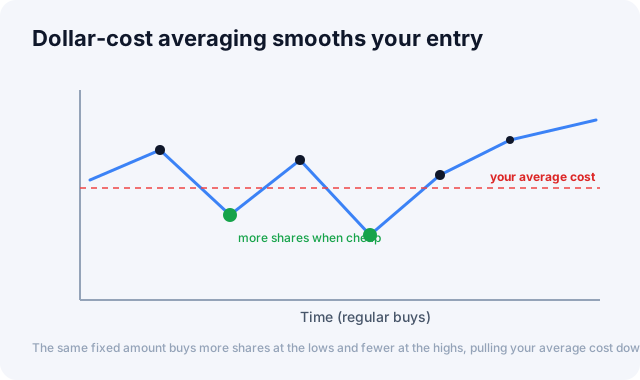
It's common for A, despite contributing for only ten years, to end up ahead of B at retirement even though B contributed for thirty. The snowball that started rolling earlier simply rolled for longer. That's the core lesson of compounding: start early, stay long. Steady monthly investing, or dollar-cost averaging, is powerful for exactly this reason. It automatically combines time and reinvestment.
What erodes compounding
Compounding works both ways. The leaks compound just as the growth does.
Fees are the quietest one. Even a 1% annual fee can eat over 20% of your final wealth across 30 years, which is why low-cost ETFs get emphasized for long-term investing. Taxes matter too: the timing of realization and the account type, taxable versus tax-advantaged, materially change the compounding effect. Inflation is another drag, since you have to subtract price increases from your nominal return to get the real compounded return. A 5% return is only 2% in real terms if inflation runs at 3%, so it helps to watch inflation (CPI) alongside your returns. The most damaging leak, though, is pulling money out early or bailing out entirely. Withdrawing principal, or panic-selling in a crash, breaks the snowball outright. That's why building a portfolio you can actually hold through a downturn, using risk management, is itself a way of protecting compounding.
FAQ
Q. I don't have a lump sum. Can I still benefit from compounding? Yes. Even a small amount each month, reinvested consistently, lets time do the work. What drives compounding is time multiplied by consistency, not the size of the sum you start with.
Q. If my return is high, can the time be short? High returns usually come with high risk. Chasing excessive returns and taking a big loss makes compounding run in reverse, because of how asymmetric losses are. Sustaining a tolerable return for a long time is both safer and more powerful than swinging for a short one.
Q. What's compounding's biggest enemy? Quitting partway through. Bailing out when markets wobble tends to miss the largest recovery stretches. Diversification and sizing you can tolerate are the insurance that keeps compounding intact.
How to apply it
- Start early and stay in for the long run. Time is your biggest weapon.
- Reinvest. Roll dividends, interest, and distributions back in rather than spending them.
- Keep costs low. Fees and taxes erode compounding more quietly than anything else.
- Diversify enough to endure volatility. Hold a portfolio you can stomach so you don't bail mid-way. See diversification and asset allocation.
Indicators worth watching alongside
To gauge the real effect of compounding, watch inflation and Treasury yields, the risk-free return, together. On the Global Market Dashboard, check price and rate indicators to see how far your expected return runs ahead of inflation. Frame the whole of investing in Getting Started with Global Markets.
Primary source: Compound interest calculator, SEC
This article is for informational purposes only and is not investment advice.