Last month, new enrollments in Korea's mandatory education course for leveraged ETF trading hit 167,000, a 19-fold jump from just 8,600 a year earlier. Leveraged and inverse ETFs are having a moment. But these products, despite the "2x" or "-2x" in their marketing, are only designed to track that multiple for a single day. That one distinction is exactly what catches long-term holders off guard.
What leveraged and inverse ETFs are
A leveraged ETF is built to deliver 2x the daily return of an underlying index; an inverse ETF targets -1x; a 2x inverse ("ultra-short") targets -2x. If an index rises 1% in a day, a 2x leveraged ETF aims to rise 2%, and a 2x inverse aims to fall 2%.
The key word is "daily." That multiple is only accurate for a single trading day, because the fund resets its exposure back to 2x (or -2x) at the close of every session, a process called daily rebalancing. As a result, the cumulative return over multiple days is not simply the index's cumulative return times the multiple.
Flat index, losing ETF
The classic illustration goes like this. If an index rises 10% one day and falls 9.09% the next, it lands exactly back where it started (100 → 110 → 100). A 2x leveraged ETF over that same stretch experiences +20% and then -18.18%, landing at 98.2, a 1.8% loss even though the underlying index went nowhere.
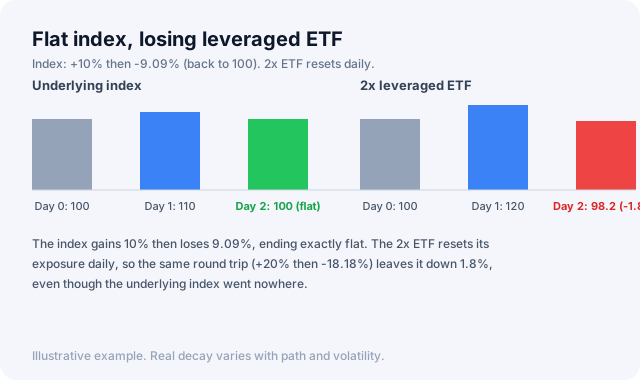
Illustrative example. Real decay varies with path and volatility.
This effect is commonly called volatility decay, or rebalancing loss. It compounds the most in a choppy, sideways market; when an index instead trends steadily in one direction, a leveraged fund can actually move by more than the simple multiple would suggest. In a real Korean example, the KOSPI 200 futures index rose 24.91% over a stretch, while its -2x inverse counterpart fell roughly 40%, not the naive -49.8% you would expect from simply multiplying. Whichever direction it goes, the point is the same: the outcome does not equal "index return × multiple."
⚠️ Note: The U.S. SEC explicitly warns that leveraged and inverse ETFs are designed around "daily" targets only, and that performance over any period longer than a single day can differ significantly from that target, potentially producing a loss even while the underlying index gains value over weeks or months.
Korea's leveraged-ETF boom and its new 2026 safeguards
These 2x-inverse products are especially popular in Korea, with money pouring into funds like KODEX's "200 Futures Inverse 2X" alongside leveraged semiconductor and KOSDAQ 150 funds. Reflecting how hot the category has gotten, new leveraged/inverse ETFs tracking single stocks like Samsung Electronics and SK Hynix launched on May 27, 2026, but only after regulators added a requirement: a 10 million won deposit and completion of a prior education course before trading. That is a noticeably higher bar than index-based versions face, a signal that regulators themselves treat this product category's risk with real caution.
So when are these actually the right tool
| Use case | Fit |
|---|---|
| Betting on today's single-day direction (short-term trading) | Matches the design intent |
| A multi-day or multi-week swing trade | Risky; higher volatility distorts the outcome more |
| Multi-month or multi-year buy-and-hold | Poor fit; can lose money even if the index moves the "right" way |
| A brief inverse hedge | Matches the design intent |
💡 Tip: The closer your holding period is to a single day, the closer these products behave to how they are marketed. The longer you hold, the less predictable they become. "The index will probably go up eventually, so I'll buy the leveraged version and hold it" is considered one of the riskier ways to use this category.
Unlike a regular ETF, these products are structurally hard to forecast over a long holding period. Keeping the position short makes strict position sizing and risk management even more important, and it is worth remembering that rebalancing losses tend to grow larger exactly when volatility itself is rising.
What to watch
The dashboard shows the VIX volatility index and the Fear & Greed Index. Since rebalancing losses in leveraged and inverse ETFs tend to grow alongside volatility, watching these gauges together is useful context.
Primary source: Leveraged and Inverse ETFs, U.S. SEC Investor.gov
This article is for informational purposes only and is not investment advice.