The tool most often recommended to first-time investors is the ETF, short for exchange-traded fund. It lets you invest in a whole market or a specific theme at once, without the burden of picking a single stock. Here's what an ETF actually is and what to look for.
What an ETF is
An ETF is a basket of many assets, essentially a fund, listed on an exchange so it can be bought and sold like a stock. Buy one share of an S&P 500 ETF, for example, and you get diversified exposure to 500 large U.S. companies.
It's similar to a traditional fund but with a crucial difference. A regular mutual fund trades once a day at a settled price, its net asset value, whereas an ETF trades instantly at a live, intraday price like a stock. It offers high liquidity and transparency and generally carries lower fees.
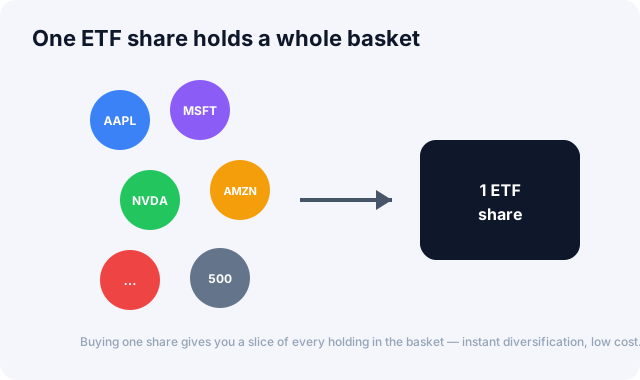
Buying one share gives you a slice of every holding in the basket: instant diversification at low cost.
Types of ETF
Index ETFs track a flagship market index such as the S&P 500, Nasdaq 100, or KOSPI, and represent the most basic kind, forming the core of passive investing. Sector ETFs concentrate on a specific industry like semiconductors, healthcare, or financials. Thematic ETFs follow trend themes such as AI, batteries, or clean energy, offering high growth potential but also higher volatility and concentration risk. Bond ETFs hold baskets of bonds like Treasuries and corporates, used for diversification thanks to a risk and return profile that differs from stocks. Commodity and gold ETFs are based on physical metals or futures like gold and oil.
Three things to check before buying
The expense ratio is the cost skimmed from assets each year. Over the long run, even a 0.1-point difference compounds into a lot, so for ETFs tracking the same index, lower fees are simply better. Tracking error measures how accurately the ETF follows its underlying index, and smaller is better here too. Liquidity, volume, and the premium or discount to net asset value matter as well: active trading and a small gap between NAV and market price make it easier to buy and sell at the price you want, while thinly traded ETFs can have wide bid-ask spreads.
Pros and cautions
On the plus side, ETFs offer instant diversification with little money, low fees, real-time trading, and transparent holdings.
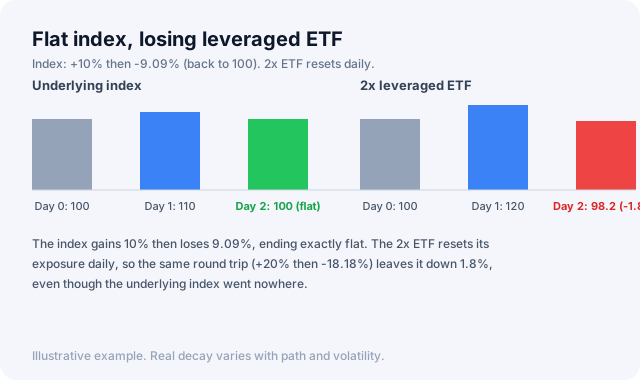
There are real cautions too. Thematic and leveraged ETFs run volatile, and leveraged or inverse products track their target on a daily basis, so holding them long term can cause compounding losses known as volatility drag. Never assume that being diversified automatically means being safe: an ETF concentrated in one sector or theme carries concentration risk in itself.
How to use them
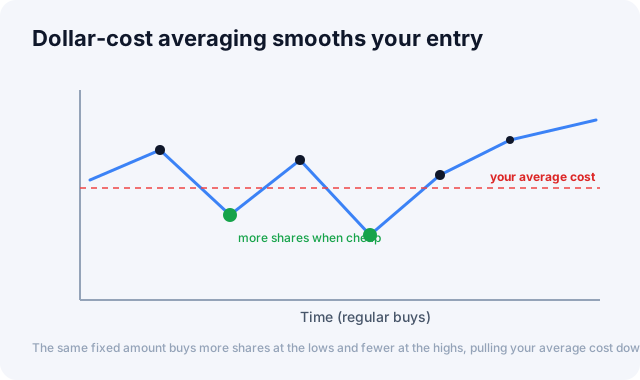
A common approach, often called core-satellite, lays down a core of broad index ETFs and adds small satellite positions in sectors or themes of interest. If timing the market feels hard, regularly investing a fixed amount through dollar-cost averaging eases the burden of volatility.
Indicators worth watching alongside
Choosing an ETF comes to life alongside the valuation of the index it tracks, the rate environment, and market sentiment.
The Global Market Dashboard shows major indices, a sector heatmap, and sentiment indicators on one screen. Use it as a starting point for seeing which indices and sectors are strong.
Primary source: ETFs, SEC investor education
This article is for informational purposes only and is not investment advice.