About the closest thing to a free lunch in investing is diversification, because it can reduce risk, meaning volatility, while keeping the same expected return. Here's how it works and how to put it into practice.
Why diversify
Put your entire net worth in one stock and you'll gain big if the company thrives, but go down with it if it collapses. Splitting across many assets reduces the impact any single piece of bad news has on the whole. The key is not simply holding many things, but holding assets that move differently from each other.
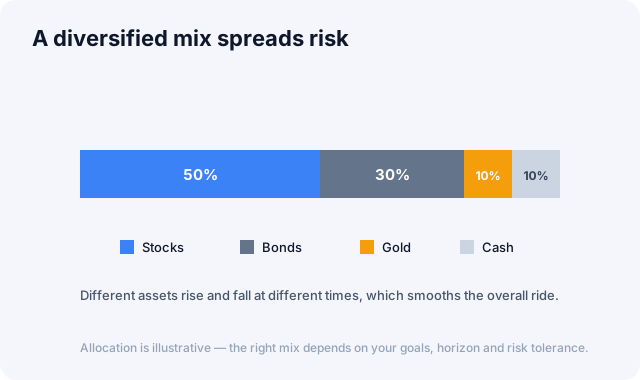
Different assets rise and fall at different times, which smooths the overall ride.
Correlation is the key
What determines the size of the diversification benefit is correlation, a value between −1 and +1 that shows how much two assets move in the same direction.
Near +1, two assets move almost identically, so there's little diversification benefit, which is what you get from holding several stocks in the same sector. Around 0, they move independently, giving a strong diversification benefit. With a negative correlation, they move in opposite directions, so one holds up when the other drops, the way stocks tend to fall and gold tends to rise in a crisis.
That's why mixing assets with different characteristics, such as stocks, bonds, gold, and cash, through asset allocation is more powerful diversification than holding 30 stocks alone. Correlation isn't fixed, though. It shifts with the market phase, and in a crisis, normally unrelated assets can fall together as correlations converge toward +1.
Asset allocation: the biggest decision
Much research finds that most of the variation in long-term returns comes from asset allocation, the mix of stocks versus bonds versus alternatives, rather than from individual stock picking. In other words, how you split your money may matter more than what you buy.
There's no single right allocation. It depends on your goals, time horizon, and risk tolerance. A commonly cited starting point is the classic stock-bond mix, to which gold, commodities, and cash get added to improve shock absorption.
Rebalancing: a tool for discipline
Over time, the assets that rose the most grow as a share of the portfolio, concentrating risk beyond your original intent. Rebalancing is the act of periodically, say semi-annually or annually, or whenever a weight drifts outside a set band, returning the weights to their target.
This process naturally turns into contrarian trading: trimming what rose and buying more of what fell, which lets you manage risk without being swayed by emotion.
The limits of diversification
Diversification reduces the idiosyncratic risk of individual assets, but it can't remove the systematic risk of the entire market falling together. Splitting too finely is also inefficient, since it becomes hard to manage and tends to converge toward the market average, erasing any differentiation. Frequent rebalancing can raise transaction costs and taxes too, so that's worth weighing.
How to use it
- Mix assets with different characteristics. Correlation matters more than the number of holdings.
- Set target weights and stick to them. Move by rules, not by market noise.
- Review and rebalance regularly. Keep risk from concentrating on one side.
Indicators worth watching alongside
Asset allocation reads more richly alongside market sentiment (fear and greed), rates and inflation, and how cross-asset correlations are trending.
The Global Market Dashboard lets you compare stocks, crypto, gold, FX, and rates on one screen, so you can see at a glance whether assets are moving in the same direction or diverging.
Primary source: Asset allocation, SEC investor education
This article is for informational purposes only and is not investment advice.