"It's a value market" or "growth is back" are phrases you hear constantly in market commentary. The two styles have taken turns leading the market for years at a time, and the shift between them isn't just fashion. It comes from a structural difference in how their valuations are calculated.
What value and growth stocks are
A value stock trades cheaply relative to its earnings or assets. These companies are typically in mature industries, generate steady profits, and often pay dividends. Banks, energy, and telecom are common examples.
A growth stock's price reflects strong expectations for future earnings growth rather than what the company earns today. Current profits may be small or nonexistent, but the stock commands a high valuation on the premise that earnings will be much larger years from now. Technology and biotech are common examples.
Why they react differently to rates
In theory, a stock's price is the present value of all the cash flows it will generate in the future. The discount rate used in that calculation is tied to interest rates, so when rates rise, the present value of every future cash flow shrinks.
The catch is that the size of the shrinkage differs by style. A value stock's cash flows are concentrated in the near future, so they're discounted less. A growth stock's cash flows sit mostly far out (five, ten years from now), so the same rate increase discounts them much more heavily. The same logic that makes a bond's duration more rate-sensitive the longer its maturity applies here too: a growth stock effectively has a longer "equity duration."
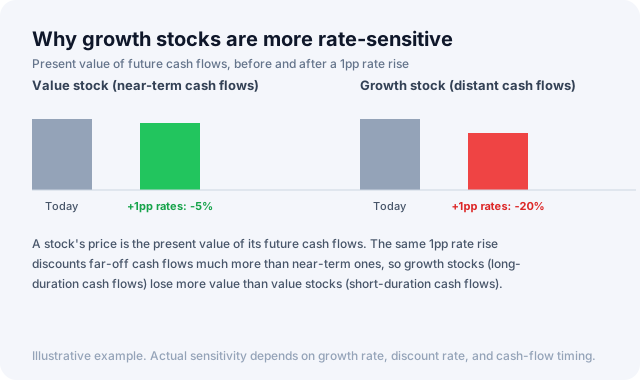
Illustrative example. Actual sensitivity depends on growth rate, discount rate, and cash-flow timing.
Style comparison
| Trait | Value | Growth |
|---|---|---|
| Valuation (P/E, etc.) | Low | High |
| Dividends | Often paid | Little or none |
| Rising-rate periods | Relatively defensive | Tends to see bigger drawdowns |
| Common sectors | Banks, energy, telecom | Technology, biotech, new industries |
| Earnings profile | Stable current earnings | Future expectations matter more than today's profit |
💡 Tip: Neither style is always right. From a diversification standpoint, holding a mix of both cushions the portfolio when the rate environment shifts, rather than leaving it fully exposed to one style's fortunes.
When the leadership rotation flips
When rates are rising (Fed hiking cycles, rising Treasury yields), growth stocks tend to underperform as their heavier discounting bites, while value holds up relatively better. When rates fall or stay low, growth's distant earnings are discounted less, tilting the advantage back its way.
This relationship isn't mechanical, though. Where the economy sits in its cycle (see sector rotation across the business cycle) and each company's own earnings trajectory within a style also matter.
Further reading
Benjamin Graham's The Intelligent Investor remains the classic reference for value investing. On the growth side, Philip Fisher's Common Stocks and Uncommon Profits is widely read for its qualitative framework for spotting exceptional companies.
In the macro tab of the dashboard, you can track Treasury yields and the Fed's policy rate. Watching which direction rates are moving is a useful way to gauge which style currently has the wind at its back. For the wider picture, see Getting Started with Global Markets.
Primary source: Fama/French Data Library, Dartmouth College
This article is for informational purposes only and is not investment advice.