Ordinary investing means buying something you expect to rise. Short selling is the mirror image: you borrow a stock you do not own and sell it, betting the price falls. The concept is simple, but the loss structure is fundamentally different from owning a stock outright, and the rules around it have shifted significantly in markets like Korea over the past few years. Here is how short selling actually works, why its risk profile is unusual, and where the rules stand today.
What short selling is
Short selling means borrowing shares, usually through a broker, selling them in the market immediately, and later buying them back at a lower price to return to the lender. The order is reversed from normal investing: borrow-and-sell first, buy-back-and-return later. Borrow and sell a $1,000 stock, buy it back at $700 once the price falls, and you pocket $300. If the price rises to $1,300 instead, you have to buy back at a $300 loss.
Borrowing is not free. You pay a borrow fee (interest) for as long as you hold the position, and if the stock pays a dividend while you are short, you owe that dividend to the lender out of your own pocket. That makes short selling a costlier bet than simply "expecting the price to fall."
Why the loss potential is unusual
With a normal long position, the worst case is the stock falling to zero, wiping out your full investment. A 100% loss is the floor. Short selling flips that structure entirely.
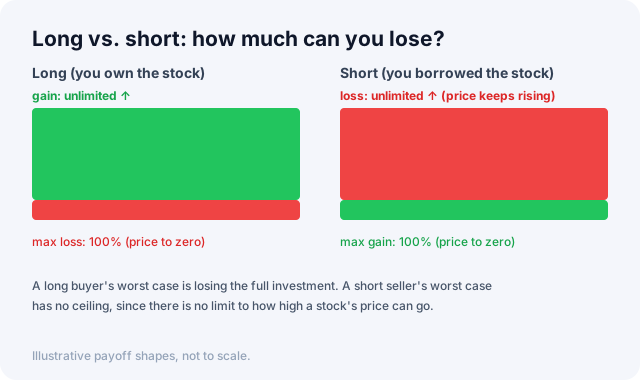
Illustrative payoff shapes, not to scale.
The maximum gain on a short position is capped at 100%, reached only if the stock falls all the way to zero. The loss side has no theoretical ceiling, because there is no limit to how high a stock's price can rise. Short a stock at $1,000 and watch it climb to $5,000 or $10,000, and your loss grows right alongside it. That asymmetry is the core reason short selling is considered far riskier than ordinary investing.
⚠️ Note: The U.S. SEC flags "no theoretical limit on potential losses" as the single biggest risk of short selling. Using margin alongside a short position amplifies that risk further.
What a short squeeze is
When a heavily shorted stock starts rising against expectations, short sellers trying to limit their losses rush to buy the stock back to close out their positions, a move called short covering. That buying itself pushes the price up further, which forces even more short sellers to capitulate and buy, creating a feedback loop. This rapid, self-reinforcing rally driven by short sellers covering their positions is called a short squeeze. The 2021 GameStop episode in the U.S. is the widely cited example of how extreme this can get.
Naked short selling and Korea's system
A legitimate short sale involves actually borrowing the shares before selling them. Naked short selling, selling shares you have not even borrowed yet, is illegal in most markets, since failing to actually deliver the shares by settlement disrupts orderly trading.
Korea banned short selling entirely starting in November 2023, then fully reinstated it at the end of March 2025. In the interim, the Korea Exchange built a real-time monitoring system (the Naked Short-Selling Detecting System, NSDS) to catch illegal naked shorting, and 2026 saw that system become mandatory alongside a revised Capital Markets Act, giving regulators a framework to investigate suspicious activity immediately. In short, the current setup is: short selling itself is legal, while naked short selling is actively monitored by the system.
What individual investors should know
| Long position | Short position | |
|---|---|---|
| Maximum gain | Unlimited | 100% (stock to zero) |
| Maximum loss | 100% (stock to zero) | Unlimited |
| Extra costs | None | Borrow fee, dividends owed |
| Short-squeeze risk | None | Yes |
💡 Tip: Shorting a stock directly usually requires a margin-enabled brokerage account and meeting certain eligibility requirements. Beyond understanding the mechanics, the asymmetric loss structure in the table above is exactly why it is generally considered a high barrier-to-entry strategy for beginners.
A stock where short interest has jumped sharply means more bets are stacked against it, but it also means the stock carries more potential for a short squeeze. Watching for sharp spikes in volatility around such stocks is worth doing, since these position unwinds are often tangled up in it.
What to watch
The dashboard shows the VIX volatility index and the Fear & Greed Index together. When selling pressure builds around a specific stock, checking whether broader market volatility and sentiment gauges move along with it helps gauge whether it is an isolated stock issue or something wider.
Further reading
Michael Lewis's The Big Short is a well-known nonfiction account of investors who profited from short selling during the 2008 financial crisis, and it shows how short selling actually plays out in real markets.
Primary source: An Introduction to Short Sales, U.S. SEC Investor.gov
This article is for informational purposes only and is not investment advice.