If you want to gauge whether the economy is improving or deteriorating before official GDP comes out, the PMI (Purchasing Managers' Index) is one of the fastest signals there is. GDP arrives more than a month after a quarter ends, and even then gets revised several times. PMI, by contrast, comes out at the start of each month, almost the moment the prior month closes. It asks corporate purchasing managers directly whether business got better than last month, so it tends to turn a step ahead of the hard economic data.
What PMI and ISM are
Both are the same idea at heart. You ask purchasing managers, the people who buy raw materials and components for a company, whether production, new orders, employment, inventories and prices rose, stayed the same, or fell versus the prior month, and you turn those answers into a single index. A purchasing manager is the first to order more materials when demand picks up, so they sit at the spot where a turn in the economy is felt earliest.
PMI itself refers to the survey-based indexes for manufacturing and services that S&P Global publishes across many countries. ISM is the US version, from the Institute for Supply Management, and comes in two flavors: ISM Manufacturing and ISM Services (also called non-manufacturing). These are the oldest and most widely watched readings in the US.
For the same US economy, S&P Global US PMI and ISM can print differently, because their company samples and methods differ. Markets traditionally give ISM more weight.
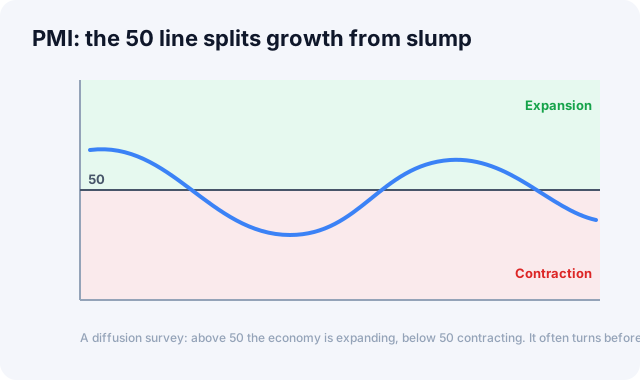
Above 50 signals expansion, below 50 contraction. As a survey it often turns before the hard data.
The 50 line
There's just one key to reading PMI/ISM: 50. The index doesn't measure how much the economy grew. It measures whether more firms say things expanded or more say they contracted.
Above 50 means expansion, with more respondents reporting improvement versus the prior month. Below 50 means contraction, with more reporting deterioration. The further from 50, the stronger the expansion or contraction: 55 and 51 are both expansion, but at very different temperatures.
A common misconception is that a PMI of 48 means the economy is shrinking. It doesn't. It just means more firms saw conditions worsen than improve, and the economy itself can still be large. Just as important is the trend. A move from 55 to 52 is still expansion, but decelerating. A move from 47 to 49 is still contraction, but may signal a bottom forming. Read the level and the direction together.
Manufacturing vs. services
Roughly 70% of the US economy is services. So while ISM Manufacturing grabs the headlines, you have to watch ISM Services to see the whole economy. Mixed phases show up often, with manufacturing contracting while services expand, and you have to combine the two to get the picture right. Manufacturing PMI is sensitive to the global trade and inventory cycle and swings more, while services better reflect the strength of domestic demand.
Reading the sub-indexes
The components inside the headline give faster, richer signals than the single number.
New Orders is the strongest leading component, foreshadowing future production. Even if the headline sits above 50, falling new orders can warn that next month is at risk. Employment hints at hiring and firing direction before the official jobs report comes out, so pair it with employment data. Prices Paid tracks the change in input costs firms face and works as a leading signal for inflation (CPI); when this spikes, consumer-price pressure often follows a few months later. Supplier Deliveries measures how long delivery times run, and longer times mean demand is overwhelming supply, a sign of overheating or bottlenecks.
What it signals for markets
A rebound in PMI is often friendly to risk assets, on hopes of better growth and earnings. Cyclicals like materials and industrials tend to react first, which ties into sector rotation. On the rates side, a hot Prices Paid reading reads as inflation or tightening risk, while a soft one reads as room to ease. A fast cooling in PMI can build expectations for Fed rate cuts.
There's a limit to how far this leads markets, though. PMI is a sentiment survey, so-called soft data, and it can diverge from hard data like actual production and sales. Sentiment can slump while real data holds up, or the reverse can happen, so don't draw conclusions from PMI alone.
PMI through history
ISM Manufacturing tends to cool ahead of recessions, which is why it's long been used as a recession lead. On its own, though, it gives frequent false alarms. Manufacturing PMI has fallen below 50 several times while services held up and no recession came. So in practice, the standard move is to cross-check PMI against other leads like the yield-curve spread.
How to use it
- Read the 50 line together with the trend. Level (expansion or contraction) and direction (accelerating or decelerating) both matter.
- Check New Orders and Prices first. They lead the headline number.
- Watch manufacturing and services together. Looking at only one misses 70% of the economy.
- Cross-check with other data. Combine PMI with jobs, retail sales, inflation, and the yield curve.
- Compare against consensus. Markets react to whether a reading beat or missed expectations almost as much as to the absolute level.
FAQ
Q. Should I watch PMI or ISM? For the US economy, lead with ISM, both manufacturing and services, given its market impact. For other countries or global comparisons, use S&P Global PMI.
Q. If PMI drops below 50, should I sell stocks immediately? No. A sub-50 print is a slowdown signal, not a confirmed recession, and false alarms are common. Judge it alongside the trend, the services reading, and other indicators. Markets often price in a PMI bottom well in advance.
Q. When is it released? ISM Manufacturing usually comes out on the first business day of the month, with Services following a few days later. You can find the schedule on the dashboard's economic calendar.
Indicators worth watching alongside
On the Global Market Dashboard, check the PMI/ISM release schedule and results in the economic calendar, and read them together with employment data, inflation (CPI), and the yield-curve spread to gauge the phase of the cycle from more than one angle. If you're just starting out, get the big picture first in Getting Started with Global Markets.
Primary source: ISM Report On Business
This article is for informational purposes only and is not investment advice.