Most market coverage focuses on the US Federal Reserve, but the Fed is one of several central banks steering the world's money. When the Fed, the European Central Bank, and the Bank of Japan pull in different directions, currencies and global rates move. Here is how they compare.
What a central bank does
A central bank sets the short-term policy rate, manages the supply of money, and works toward a mandate set by law. Raising rates cools the economy and inflation; cutting rates supports growth. The details of that transmission are covered in the guide on the Fed and FOMC meetings.
It is worth knowing that a central bank does not simply decree a rate. It steers the rate at which banks lend to each other overnight, mainly by controlling the supply of reserves in the banking system and by setting the rate it pays on those reserves. Everything else, from mortgages to corporate loans, prices off that anchor. The policy rate is a lever on the very short end, and the rest of the curve is the market's guess about where that lever goes next.
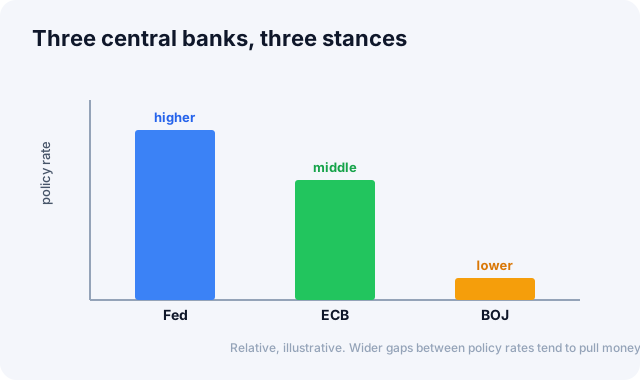
Relative, illustrative. Wider gaps between policy rates tend to pull money toward the higher-yielding currency.
The second lever: QE and QT
Once the policy rate is near zero there is nothing left to cut, so central banks reach for the balance sheet. Quantitative easing (QE) means creating reserves to buy bonds, which pushes up their price and pushes down long-term yields, pressing on the part of the curve the policy rate cannot reach directly. Quantitative tightening (QT) is the reverse: letting those bonds mature without replacing them, quietly draining the system.
This matters because a bank can be tightening and easing at once. It can cut the policy rate while still shrinking its balance sheet, or hold rates steady while buying bonds. Reading only the headline rate misses half of the stance.
The Fed, the ECB, and the BOJ
The three biggest developed-market central banks share a 2% inflation goal but differ in mandate and temperament.
| Bank | Focus | Stance |
|---|---|---|
| Fed (US) | Jobs and 2% inflation | Most proactive |
| ECB (Euro area) | Price stability first, 2% | Slower, consensus across members |
| BOJ (Japan) | 2% after a long deflation fight | Long ultra-loose, gradually normalizing |
The Fed carries a dual mandate, so it reacts to both jobs and prices. It also has a burden no other bank has: the dollar is the world's funding and reserve currency, so a Fed decision made purely for American reasons reprices debt in Jakarta and Johannesburg. When the Fed tightens, dollar borrowers everywhere feel it.
The ECB sets one policy for many economies, which makes it more consensus-bound and structurally harder. A single rate must serve countries with very different growth and debt. When investors doubt one member's finances, its bond yields can pull away from the rest even though monetary policy is identical. That risk of the euro area's borrowing costs pulling apart, known as fragmentation, is a problem the Fed and the BOJ simply do not have.
The Bank of Japan spent decades fighting deflation, and used a tool the others avoided: yield curve control, which caps a longer-term yield rather than only the overnight rate, defending that cap by buying however many bonds it takes. It has only slowly stepped away from that stance. The BOJ's problem was never cooling an economy; it was convincing a country that prices would rise at all.
Why their differences matter
When one bank hikes while another holds, the gap between their rates widens, and money tends to flow toward the higher-yielding currency. That is a major driver of moves like a stronger dollar against the yen.
💡 Tip: A simple lens is the rate gap. If US rates sit far above Japan's, it pressures the yen weaker and the dollar stronger. See what moves a currency for the full picture.
The sharpest example is the carry trade. When Japanese rates sit near zero and US rates are far higher, investors borrow cheaply in yen and buy higher-yielding assets elsewhere, pocketing the difference. It works quietly for years and then unwinds violently: if the BOJ tightens or the yen suddenly strengthens, those positions must be bought back at once, and the resulting scramble can shake markets that have nothing to do with Japan. Policy divergence builds the trade; policy convergence detonates it.
Reading the meetings
Each bank holds scheduled meetings (the Fed's FOMC, the ECB Governing Council, the BOJ policy meeting) where it sets rates and signals what comes next.
⚠️ Caution: The headline decision often matters less than the guidance. Markets move on the tone about future policy, so a hike paired with dovish language can still lift stocks.
The reason words carry so much weight is that policy works through expectations. A rate set today matters less than the path the market believes is coming, because that path is what prices five-year loans and equity valuations. Central banks know this, so they use language deliberately, and a single adjective can be the whole event.
Independence, and why it is guarded
These banks are designed to be insulated from elected governments. The logic is uncomfortable but simple: politicians face elections, and cheap money is popular before one, so a government that controls the printing press faces a standing temptation to inflate. Independence exists to make the promise of stable prices credible over the long run. When markets suspect that independence is slipping, they usually demand higher long-term yields and a weaker currency in compensation, which is why any hint of political pressure on a central bank tends to show up in the bond market before anywhere else.
What to watch
Policy divergence shows up first in rates and the dollar. Track the Dollar Index and, for Korea, USD/KRW and foreign flows, where Bank of Korea decisions are often shaped by what the Fed does. The Global Market Dashboard puts rates, the dollar, and the economic calendar on one screen.
Further reading
For how modern central banking took on so much of the burden, Mohamed El-Erian's The Only Game in Town is an accessible and well-regarded read.
Primary source: ECB monetary policy
This article is for informational purposes only and is not investment advice.