Stock investors watch stocks. Professionals watch credit. The reason is that the people who lend money tend to notice trouble before the people who own shares do, and where they notice it is the credit spread.
What a credit spread is
A credit spread is the extra yield a company must pay over a government bond of the same maturity. Governments are treated as the safest borrower, so anyone riskier pays a premium. That premium is the market's price for the chance of not being paid back.
When lenders feel calm, they accept a slim premium and spreads are narrow. When they get nervous, they demand much more, and spreads widen.
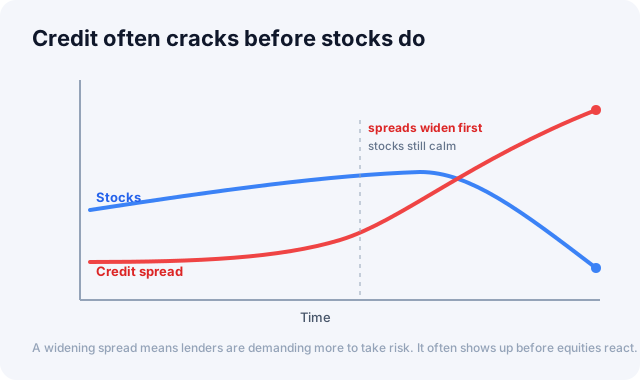
A widening spread means lenders are demanding more to take risk. It often shows up before equities react.
Why it warns early
Bondholders only get their money back plus interest, so their whole job is worrying about what can go wrong. Shareholders are paid to dream about upside. That asymmetry makes credit markets the more paranoid, and usually the earlier, judge of stress. When companies suddenly must pay far more to borrow, the squeeze reaches earnings and hiring well before the equity market prices it.
💡 Tip: Watch the direction, not the level. Spreads grinding wider week after week while stocks make new highs is one of the more useful divergences in markets.
High-yield bonds and HYG
High-yield (or junk) bonds are issued by companies below investment grade. They pay more precisely because default risk is real, which makes them the most sensitive corner of credit.
| Signal | What it suggests |
|---|---|
| Spreads narrow, HYG firm | Lenders relaxed, risk-on backdrop |
| Spreads widening slowly | Caution building under the surface |
| Spreads spike, HYG drops | Risk-off, funding getting expensive |
HYG is a widely traded high-yield bond ETF, which makes it a convenient live proxy: when HYG falls while spreads widen, credit appetite is draining.
⚠️ Caution: Spreads can widen for two very different reasons. Sometimes it is genuine fear of defaults; sometimes it is just rising government yields dragging everything along. Check whether the 10-year yield is doing the work before calling it a credit event.
Reading it in practice
Narrow and stable spreads describe a market where money is cheap and lenders are willing, which supports equities. Rapid widening says the opposite: financing is tightening, weak companies get squeezed first, and the market starts pricing that. It rarely stays contained to bonds.
What to watch
Credit pairs naturally with volatility and sentiment. If spreads widen while the VIX climbs and the Fear & Greed Index drops, the message is consistent rather than noise.
The Global Market Dashboard shows high-yield corporate bonds (HYG), the yield curve, and sentiment gauges on one screen, which is the fastest way to check whether credit agrees with what stocks are doing.
Further reading
For how credit cycles build and break, Howard Marks's Mastering the Market Cycle is a clear, experienced take on reading risk appetite.
How FearGrid's Market Signal reads this
Credit spreads are also a direct input to the Market Signal index that FearGrid computes itself from public data. Among the index's three pillars, the sentiment and stress pillar draws on the Chicago Fed's NFCI risk and credit subindices (the same data this article cites as its primary source). When credit conditions tighten, this pillar responds right away. It is the heaviest of the three at 45%, so moves in credit spreads weigh especially heavily on the composite score.
The index converts the reading not into an absolute level but into its position relative to the past three years (the three-year average sits in the middle), so you can see at a glance how stressed the credit market is versus normal. Check the Market Signal at the top of the home page to see where this pillar sits now.
Primary source: NFCI, Chicago Fed
This article is for informational purposes only and is not investment advice.