Bonds get lumped in with safe investing, yet how their prices are set, and why they move opposite to yields, is surprisingly confusing. The bond market is actually larger than the stock market and closer to the benchmark for everything, steering rates, FX, and equities alike. Get the basic structure down and market news reads far more clearly.
What a bond is
A bond is an IOU that a government or company issues to borrow money. The investor buys the bond, collects fixed interest called the coupon, and gets the principal, or face value, back at maturity. Three elements define it.
Face value is the principal returned at maturity, a set amount per bond. The coupon is the interest rate fixed at issuance, so a 5% coupon on a $1,000 face value pays $50 a year. Maturity is when the principal gets repaid, anywhere from under a year to 30-plus years out.
The coupon is fixed at issuance, but a bond can be bought and sold before maturity. The key is that the traded price changes with market interest rates.
Why price and yield move inversely
The coupon on an already-issued bond is fixed. But when market rates change, the situation shifts. When market rates rise, newly issued bonds pay more interest, so an older bond with a lower coupon loses appeal and its price has to fall to offer a new buyer the same yield. When market rates fall, the older bond with its higher coupon becomes attractive instead, so its price rises.
Here's a simple example. You buy a 3%-coupon bond at $1,000 face value, then market rates rise to 5%. New bonds now pay 5% while yours pays only 3%, so for anyone to buy yours, the price has to drop until the effective yield reaches 5%. Your bond's market price falls below $1,000.
This is why bond prices and yields always move in opposite directions. "Yields rose" and "bond prices fell" are essentially the same statement. When the news says Treasury yields spiked, that means Treasury prices dropped.
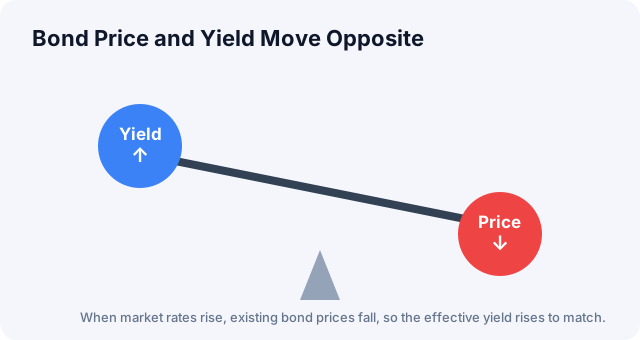
When market rates rise, an existing bond's price falls, so its effective yield rises to match.
Maturity and duration
Duration measures how sensitive a bond's price is to a change in rates. Generally, the longer the maturity, the longer the duration, and the bigger the price swing, gain or loss, for the same move in rates.
For instance, a bond with a duration of about 8 years falls roughly 8% in price when rates rise 1 percentage point. That's why a 30-year bond, though called a safe asset, can swing nearly as much as stocks when rates move. Safe means the issuer won't default, which is a statement about credit, not that the price won't move. Confusing the two is how people get blindsided by losses in long-term Treasury funds.
Credit rating and credit spreads
The risk that the issuer can't repay, known as credit risk, gets priced in too. The lower the rating, the higher the yield needed to sell the bond, and how much more it pays over a safe government bond of the same maturity is called the credit spread.
In good times, spreads narrow as investors grow more willing to take on risk. When spreads widen during times of stress, it's a powerful signal that risk aversion is rising, and the bond market often sounds the alarm before stock prices fall. For this reason, high-yield bond spreads, covering the high-return, high-risk end of the market, are sometimes called the market's hidden fear gauge.
The role of bonds
Bonds provide income through regular interest payments, which matters most to retirees or anyone who needs steady cash flow. They also tend to move differently from stocks, which lowers portfolio volatility, though not always: in periods of spiking inflation, stocks and bonds have fallen together. And in a crisis, money tends to flood into safe assets, especially US Treasuries, lifting their prices and offsetting some equity losses, a role often described as ballast.
These roles connect directly to why bonds are a core pillar in diversification and asset allocation.
FAQ
Q. Should I always avoid bonds when rates are rising? After rates have already risen a lot, bonds can actually be attractive, since you can lock in the higher coupon as a fixed return. What matters is the future direction of rates, and short-maturity bonds carry less rate risk as an alternative.
Q. If I hold to maturity, can I avoid losses? Barring a credit event, you get face value back at maturity, so an interim price drop is never realized. What remains is the opportunity cost of missing higher rates along the way and the erosion of real value from inflation.
Q. How do individuals invest in bonds? You can buy individual bonds directly, but for diversification and convenience, bond ETFs are common. Just remember a bond ETF has no maturity date, so price swings flow straight through to you.
Indicators worth watching alongside
Government yields, especially the US 10-year, and the yield-curve spread are the bond market's thermometer, and the body that sets rates is the Fed and the FOMC. On the Global Market Dashboard, check US 2Y, 10Y, and 30Y yields and the 10Y-2Y spread to gauge the rate environment. For the whole picture, start with Getting Started with Global Markets.
Primary source: Bonds, SEC investor education
This article is for informational purposes only and is not investment advice.