Inflation is the quietest way to lose money. Nothing in your account goes down, yet every year the same balance buys a little less. When prices rise 5% and cash earns 1%, the loss is just as real as a falling stock, only invisible on the statement. An inflation hedge is any asset whose job is to keep your purchasing power intact when that happens. The catch is that every hedge charges a price for the protection, and the prices differ a lot.
Why cash and plain bonds lose the fight
A regular bond promises fixed nominal payments: the same coupon, the same principal, no matter what a loaf of bread costs at maturity. That is exactly the wrong shape for inflation. If prices rise faster than the bond's yield, the real value of every future payment shrinks, and longer-duration bonds get hit twice, because central banks usually respond to inflation by raising rates, which pushes bond prices down at the same time.
Cash fails more slowly but just as surely. Deposit rates tend to lag inflation, especially early in an inflationary episode, so "safe" cash quietly compounds a real loss. This is the problem every hedge below is trying to solve.
The candidates, one by one
TIPS: the only contractual hedge
Treasury Inflation-Protected Securities are the one asset where the inflation link is written into the security itself: the principal is adjusted with the Consumer Price Index, and coupons are paid on the adjusted principal. If CPI rises 10%, the bond's principal rises 10% by design, not by market mood.
The cost of that certainty is a modest real yield, and TIPS still carry ordinary interest-rate risk: if real yields rise, TIPS prices fall even while inflation runs hot, which is exactly what happened in 2022. They protect purchasing power at maturity, not price stability along the way.
Commodities: the cause, not just a hedge
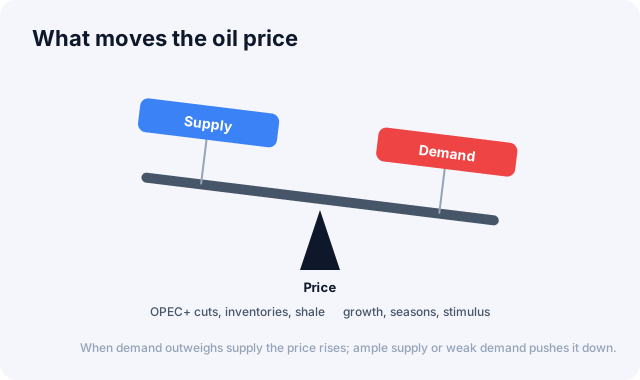
Energy and food are often what an inflation spike is made of, so a broad commodity basket tends to rise with the very prices that show up in CPI a month later. In supply-shock inflation, the kind driven by oil or crop failures, commodities are usually the fastest responder of anything on this list.
The bill for that responsiveness is steep: commodities pay no income, swing violently, and can spend a decade going nowhere between inflation episodes. They are a spike hedge, not a buy-and-forget holding.
Gold: a store of value on a loose leash
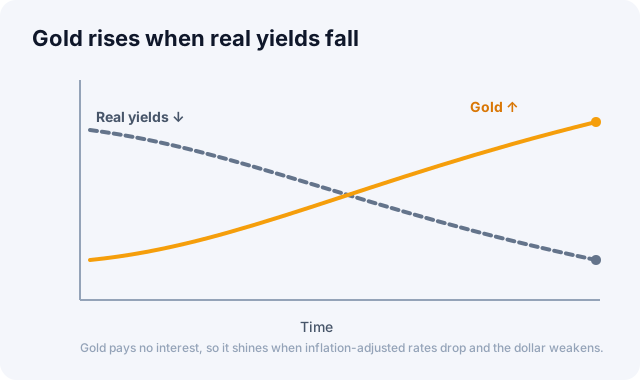
Over generations, gold has held purchasing power remarkably well. Over any given year, its link to CPI is loose: gold responds more directly to real yields and the dollar than to last month's inflation print. It can sit flat through an inflationary year if real rates are rising, and surge in a deflation scare if rates collapse.
Gold is better described as a hedge against extreme scenarios and lost confidence in currencies than as a CPI tracker. It earns its place over decades, not quarters.
Real estate and REITs: rents reprice, with a lag
Property rents and replacement costs tend to follow inflation over time, which makes REITs a reasonable long-run hedge. Leases reset, rents climb, and the nominal value of buildings drifts up with construction costs.
The lag is the catch. In the short run REITs trade like rate-sensitive stocks: when inflation pushes yields up, REIT prices usually fall first and collect the higher rents later. The hedge works on a multi-year horizon, not during the spike itself.
Stocks: the long-run winner that fails during spikes
Broad stock indexes have beaten inflation over almost every long horizon, because companies eventually pass higher costs into higher prices and earnings. But during the spike itself, stocks often do poorly: costs rise before prices can be raised, and the rate hikes that fight inflation compress valuations. Stocks are the engine of long-run real returns, not a shelter for the inflationary quarter.
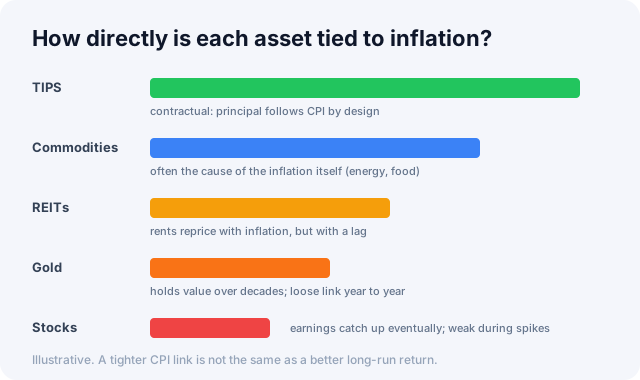
Illustrative. A tighter CPI link is not the same as a better long-run return.
Side by side
| Asset | How it hedges | Works best in | Main cost |
|---|---|---|---|
| TIPS | Principal indexed to CPI | Any inflation, held to maturity | Low real yield, rate risk |
| Commodities | Are the rising prices | Supply-shock spikes | No income, brutal swings |
| Gold | Store of value, currency distrust | Crises, negative real rates | No income, loose CPI link |
| REITs | Rents reprice over time | Gradual inflation, years out | Falls first when rates rise |
| Stocks | Earnings catch up | Long horizons | Weak during the spike itself |
⚠️ Note: A hedge protects against unexpected inflation. If markets already expect 3% inflation, that number is priced into everything, and an asset only "pays off" when reality comes in hotter than expected. Buying inflation hedges after the CPI headlines peak is often buying protection at its most expensive.
Combining them: the honest answer
No single asset hedges inflation cheaply, quickly, and reliably at once. TIPS are reliable but yield little. Commodities are fast but wild. Gold and REITs work on horizons of years to decades. That is an argument for diversification rather than for picking a champion: a small permanent sleeve of real assets does more good than a large bet made mid-spike.
💡 Tip: Ask what kind of inflation you are hedging. Demand-driven inflation with a strong economy tends to favor stocks and REITs; supply-shock inflation favors commodities and TIPS; a loss of confidence in the currency favors gold. The CPI guide covers how to read the inflation data itself.
What to watch
The dashboard shows the pieces of this picture in one place: CPI trends in the macro summary, the 10-year Treasury yield whose real component drives gold and REITs, the dollar index, and gold and oil prices themselves. Watching real yields alongside CPI tells you more about how these hedges will behave than the inflation headline alone.
Further reading
For the long-run evidence on how stocks, bonds, and gold have fared against inflation across two centuries, Jeremy Siegel's Stocks for the Long Run is the standard reference and is written for regular investors, not academics.
Primary source: Treasury Inflation-Protected Securities, U.S. TreasuryDirect
This article is for information only and is not investment advice.