You have probably heard the advice to "diversify into emerging markets." It sounds like spreading money broadly across many fast-growing countries. Open up an actual emerging-markets index, though, and the money is concentrated in a much narrower place than that phrase suggests. Here is what emerging-markets investing actually buys, why it appeals to investors, and why its returns are unusually sensitive to the direction of the dollar.
What emerging markets are
Emerging markets are economies that are growing quickly but have not yet reached the maturity of developed markets. Under MSCI's classification, 24 countries qualify, including China, India, Taiwan, South Korea, and Brazil. Compared with developed markets, they typically offer more growth potential but less mature market infrastructure, disclosure standards, and liquidity.
In practice, it is four countries
Despite the "diversification" pitch, the flagship MSCI Emerging Markets Index is heavily concentrated in a handful of countries.
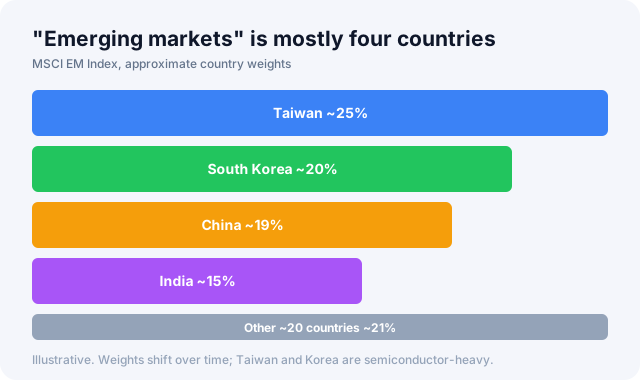
Illustrative. Weights shift over time; Taiwan and Korea are especially semiconductor-heavy.
Taiwan (roughly 25%), South Korea (roughly 20%), China (roughly 19%), and India (roughly 15%) together make up around 80% of the index, leaving the other 20 countries to split the remaining 20%. Taiwan and South Korea are also unusually concentrated in semiconductor companies. So rather than the evenly spread 24-country basket the marketing suggests, an EM index fund is closer to a portfolio dominated by East Asian tech and chip manufacturing. It is worth checking a fund's actual holdings before buying it for that reason alone.
Why invest in emerging markets at all
Two reasons come up most often. One is growth: emerging markets often still have expanding populations, a growing middle class, and industrialization underway, all of which can support higher economic growth than developed markets typically offer. The other is diversification: because emerging markets do not move in perfect lockstep with U.S. stocks, adding some exposure can smooth out a portfolio's overall swings.
The 2025 MSCI EM Index gained more than 33%, and 2026 opened with further gains. That path is rarely smooth, though. Emerging markets tend to be more volatile than developed ones, with sharper moves on both the way up and the way down.
The tight link to the dollar
One of the biggest single swing factors for emerging-market returns is the dollar. When the dollar weakens, emerging-market assets generally do well, for two reasons. First, many emerging-market companies and governments borrow in dollars, so a weaker dollar shrinks the real burden of repaying that debt in local-currency terms. Second, a weak-dollar environment tends to send investors searching for higher returns abroad, and emerging markets are a common destination for that money.
When the dollar strengthens, the pattern reverses: local currencies weaken, foreign capital tends to flow out, and dollar-denominated debt gets harder to service. If you are considering emerging-market exposure, checking whether the dollar is in a strengthening or weakening phase matters just as much as any individual country's growth story.
The risks worth knowing
⚠️ Note: The U.S. SEC flags a few specific risks with emerging-market investing. Companies listed in emerging markets are often not held to the same disclosure standards as U.S. companies, so the quality and reliability of available information can be lower. Investor protections common in the U.S., such as class-action securities suits, are difficult or outright impossible to pursue in many emerging markets. An index fund that simply tracks the benchmark does not adjust its weights for these differences in investor protection; it weights purely by market capitalization.
Currency risk stacks on top of that. Even if local share prices rise, a weakening local currency can erode the return once converted back to dollars or won. Political instability, capital controls, and thinner liquidity also make it harder to sell when you want to, more often than in developed markets.
How to actually get exposure
Picking individual emerging-market stocks is especially hard for individual investors given the information gaps described above. A more realistic route is broad exposure through an ETF, though as shown above, it is worth checking what a given fund actually holds, by country and by sector, before assuming it is well diversified. How much emerging-market exposure to carry is best decided within your overall asset allocation plan rather than as a standalone bet.
How to read it
- Do not take "diversified" at face value. Look at the actual holdings; concentration in a handful of countries and sectors is common.
- Watch the dollar alongside it. Emerging-market performance is driven as much by dollar strength or weakness as by any single country's fundamentals.
- Size the position for the volatility. Higher expected returns come with sharper drawdowns, so treat it as one slice of a portfolio, not the whole thing.
What to watch
The dashboard shows the Dollar Index (DXY), the USD/KRW exchange rate, and the 10-year Treasury yield together. Tracking the direction of all three at once helps gauge whether conditions currently favor or work against emerging-market assets.
Primary source: International Investing, U.S. SEC Investor.gov
This article is for informational purposes only and is not investment advice.