Nobody reliably times the bottom. That is the whole appeal of dollar-cost averaging: invest a fixed amount on a schedule and stop trying to outguess the market. But is it actually better than investing everything at once? The honest answer has two sides.
What dollar-cost averaging is
Dollar-cost averaging, or DCA, means investing a fixed amount at regular intervals, say monthly, regardless of the price that day. You are not predicting anything, you are just showing up on schedule. Most retirement contributions already work this way by default.
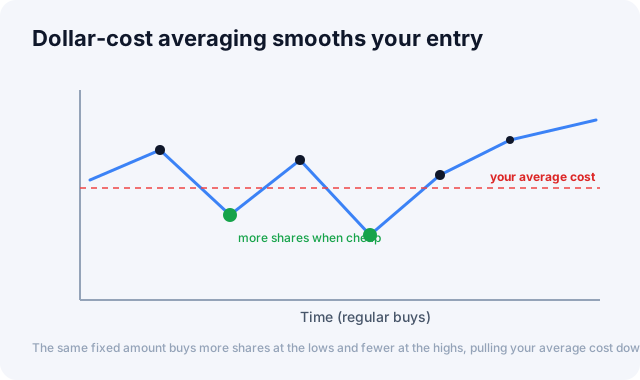
The same fixed amount buys more shares at the lows and fewer at the highs, pulling your average cost down.
Why it lowers your average cost
Because the amount is fixed rather than the number of shares, the same money buys more shares when the price is low and fewer when it is high. Over the period your average cost per share lands below the average price.
💡 Tip: This is arithmetic, not magic. Fixed dollars buy more units at lower prices, so your average cost gets pulled toward the lows.
It is worth being precise about what that does and does not prove. Your average cost being below the average price is guaranteed by the arithmetic. It does not mean your average cost beats the price you would have paid by investing on day one. Those are different claims, and the second one depends entirely on which way the market went.
DCA versus lump sum: what the research says
Historically, investing a lump sum has beaten spreading it out roughly two-thirds of the time. The reason is unglamorous: markets rise more often than they fall, so money waiting on the sidelines misses that upward drift. That average, though, hides the pain of the unlucky third who invest right before a drop.
| Dollar-cost averaging | Lump sum | |
|---|---|---|
| Timing risk | Lower | Higher |
| Average return | Usually slightly lower | Usually slightly higher |
| Best suited to | Steady income, nervous investors | A windfall with a long horizon |
The logic is simple once you see it. Money not yet invested is sitting in cash, and cash has historically returned less than stocks. Spreading purchases over twelve months means that, on average, half your money was in cash for half a year. You are paying an expected return to buy something else, and what you are buying is a narrower range of outcomes.
The real case for DCA is behavioral
The strongest argument for averaging in has little to do with returns. It is that most people cannot actually sit through the bad version of lump sum.
Losses hurt roughly twice as much as equivalent gains feel good, a pattern behavioral researchers call loss aversion. So an investor who puts everything in on Monday and watches it fall 20% by Friday does not calmly recite the statistics about two-thirds. They sell. And selling at the bottom converts a temporary drop into a permanent loss, which is far worse than the small expected return that DCA gave up.
Seen that way, DCA is not a return strategy at all. It is insurance against your own behavior, and the premium is a little expected return. For a lot of people that is a genuinely good trade, because a strategy you can actually stick with beats a better strategy you abandon.
⚠️ Caution: DCA reduces regret, not the risk of loss. Averaging into an asset that keeps falling just means buying more of something that keeps falling. It does not rescue a bad investment.
A cousin worth knowing: value averaging
There is a variant called value averaging, where instead of investing a fixed amount you target a fixed growth in your portfolio value, buying more when the market has fallen and less (or even selling) when it has run up.
In backtests it often edges out DCA, because it leans harder into weakness. In practice it asks you to invest the most money exactly when the news is worst, and it can demand contributions you do not have. That is a lot to ask of the same psychology that DCA was protecting. It is worth knowing about, but the extra discipline it requires is not free.
When each makes sense
If you earn and invest monthly, DCA is not really a choice, it is just how your cash flow works. If a lump sum lands in your lap, the math favors putting it to work, but only if you can stomach an immediate drop. Splitting the difference by investing over a few months buys peace of mind at a small expected cost.
One honest test: imagine investing it all tomorrow and the market falling 25% next month. If your answer is that you would hold, take the math and invest the lump sum. If your answer is that you would probably sell, that is not a character flaw, it is useful information, and averaging in over six to twelve months is the strategy that fits the investor you actually are.
What to watch
DCA works best paired with broad, diversified holdings, which is why it fits index ETFs and a sensible allocation. Its real engine is time, as covered in the guide on compounding.
The Global Market Dashboard shows sentiment and volatility, which helps you keep perspective when a scheduled buy happens to land in a scary week.
Further reading
John Bogle's The Little Book of Common Sense Investing makes the case for steady, low-cost index investing about as clearly as anyone has.
Primary source: Dollar-cost averaging, SEC
This article is for informational purposes only and is not investment advice.