Owning property usually means a large down payment, a mortgage, and a tenant who calls at midnight. A REIT lets you skip all of that and own a slice of income-producing real estate through a single listed share. Here is how they work.
What a REIT is
A REIT, or real estate investment trust, is a company that owns and operates income-producing property: offices, malls, warehouses, apartments, data centers. It collects rent, and in exchange for special tax treatment it must pay out most of its taxable income to shareholders, typically 90% or more. That legal requirement is exactly why REIT dividends tend to be high.
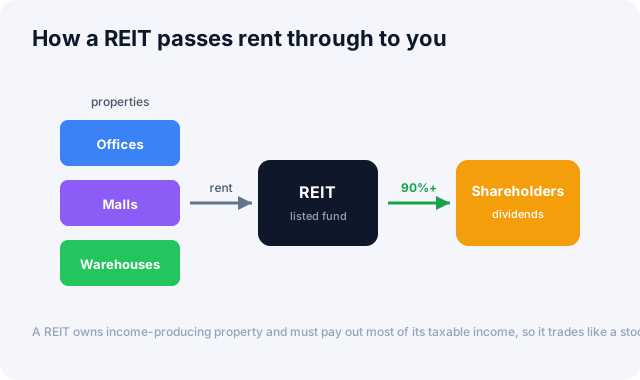
A REIT owns income-producing property and must pay out most of its taxable income, so it trades like a stock but pays like rent.
Why the dividends are so high
A normal company can reinvest all its profit. A REIT cannot hoard it; the payout requirement forces cash out the door. That makes REITs a popular income holding, but it also means they must raise money by issuing shares or borrowing in order to grow, which makes them sensitive to the cost of debt.
💡 Tip: Judge a REIT on FFO (funds from operations), not ordinary earnings. Property depreciation is a large accounting charge that does not reflect real cash, so net income understates what a REIT actually earns.
The main types
| Type | Owns | Sensitive to |
|---|---|---|
| Equity REIT | Physical property, collects rent | Occupancy, rents, rates |
| Mortgage REIT | Property loans, collects interest | Rates and spreads (more volatile) |
| Sector REITs | Data centers, logistics, healthcare | That sector's demand cycle |
Most beginners are better served by broad equity REITs or a REIT ETF than by mortgage REITs, which use leverage and swing hard when rates move.
Why rates matter so much
REITs are among the most rate-sensitive corners of the market. Higher rates raise their borrowing costs, and they also make bonds a more attractive alternative to a REIT's dividend, so money rotates away. When long-term yields jump, REITs usually feel it fast.
⚠️ Caution: A very high dividend yield is often a warning, not a bargain. It can mean the market expects a cut, or that the price already fell because tenants are leaving. Check whether FFO actually covers the dividend.
What to check before buying
Look at occupancy, the quality and diversity of tenants, debt levels and when that debt matures, and whether FFO comfortably covers the payout. Then look at the rate environment, because that sets the backdrop for all of it.
What to watch
Rates drive REITs more than almost anything else, so track the 10-year yield and the Fed's policy path. If you like the income angle, the guide on dividend investing pairs naturally with this one.
The Global Market Dashboard shows Treasury yields and the curve on one screen, which is the fastest way to see whether the backdrop is turning against REITs.
Further reading
For a broader treatment of income investing that covers REITs in context, Burton Malkiel's A Random Walk Down Wall Street remains a solid, readable starting point.
Primary source: REITs, SEC investor education
This article is for informational purposes only and is not investment advice.