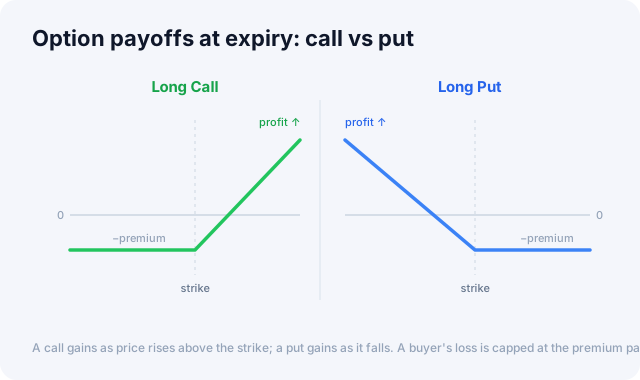
An option's price doesn't move on the underlying's price alone. It also reacts to how fast that price is changing, how much time is left, and what the market expects volatility to do. The Greeks split an option's price sensitivity into these separate pieces. The name comes from the Greek letters used to label them, but each one is just a number answering "if this variable moves by 1, how much does the option's price move?"
Delta: sensitivity to direction
Delta measures how much an option's price moves when the underlying moves by 1. A call's delta runs from 0 to 1, a put's from -1 to 0. An option with a delta of 0.5, for example, gains about $0.50 when the underlying rises by $1.
Delta is also commonly used as a rough estimate of the probability an option finishes in the money at expiration. An option near 0.5 delta is roughly at the money; closer to 1 means deep in the money, closer to 0 means deep out of the money.
Gamma: how fast delta itself changes
Gamma measures how much delta changes when the underlying moves by 1. If delta is speed, gamma is acceleration.
Gamma is largest for at-the-money options and grows as expiration approaches. High gamma means delta, and therefore the position's risk exposure, can shift quickly even on small moves in the underlying. This matters especially for option sellers, whose positions can lose money faster than expected when gamma is high.
Theta: how time value disappears
Theta measures how much an option's price falls with each passing day. An option behaves like a wasting asset that loses value as time passes, a process known as time decay.
The key detail is that this decay isn't linear. It stays modest while expiration is far off, then accelerates sharply as expiration approaches.
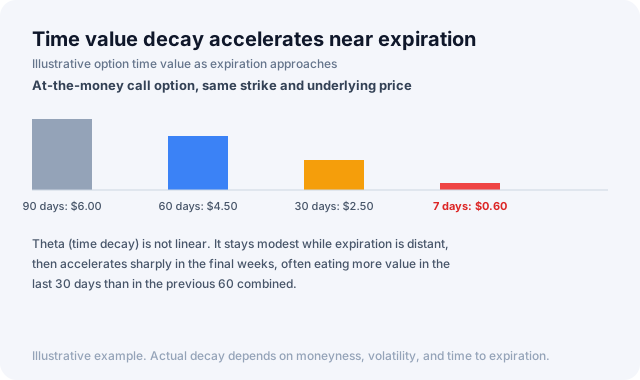
Illustrative example. Actual decay depends on the option's intrinsic value, volatility, and time remaining.
⚠️ Note: Hold a long option all the way to expiration and you can lose money to time decay alone, even if the underlying's price doesn't move at all. Theta's bite is sharpest in the final 30 days before expiration.
Vega: what happens when volatility expectations shift
Vega measures how much an option's price changes when implied volatility moves by 1 percentage point. When implied volatility rises, both calls and puts gain value, since higher volatility raises the odds of a large price swing; when implied volatility falls, the reverse happens.
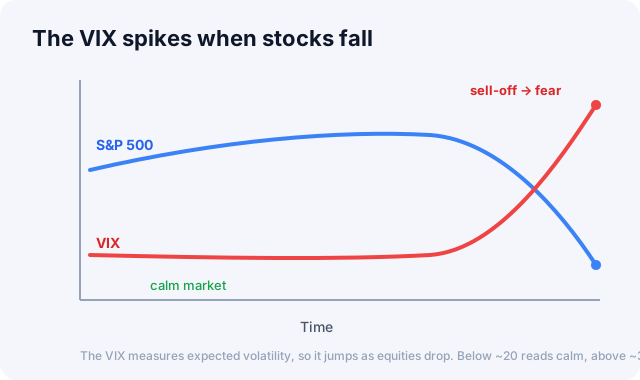
Vega is largest for options with more time left and closer to the money. When the VIX volatility index spikes, options with high vega can jump in price even if the underlying itself hasn't moved.
The four Greeks side by side
| Greek | What it measures | Grows largest when | What it means in practice |
|---|---|---|---|
| Delta | Option price change per $1 move in the underlying | Deeper in the money | Size of directional exposure |
| Gamma | Delta's change per $1 move in the underlying | At the money, near expiration | How fast exposure itself can shift |
| Theta | Option price lost per day | Near expiration, at the money | Cost of holding, works against buyers |
| Vega | Option price change per 1pp move in implied volatility | Plenty of time left, at the money | Exposure to sudden volatility shifts |
💡 Tip: If you're new to options, don't try to memorize all four Greeks at once. Start with whichever one matters most for the position you actually hold or are considering, usually delta or theta.
Putting it to work
Once you understand the basic structure of calls and puts from options basics, the Greeks are the next step: they let you quantify exactly what risk a position carries and how much of it. A short-term directional bet lives or dies on delta; a position held near expiration lives or dies on theta; a bet on volatility expanding lives or dies on vega.
The Greeks matter for position sizing too. Buying several high-delta options can carry roughly the same directional exposure as owning a large chunk of the underlying, so the same position sizing and risk management principles apply just as much to options.
Further reading
Sheldon Natenberg's Option Volatility and Pricing remains a classic reference among practitioners for a systematic treatment of option volatility and pricing.
The dashboard tracks the VIX volatility index in real time. Watch it closely when volatility is spiking or collapsing, since that's exactly when vega matters most. For the wider picture, see Getting Started with Global Markets.
Primary source: Characteristics and Risks of Standardized Options, U.S. Options Clearing Corporation (OCC)
This article is for informational purposes only and is not investment advice.