Government bonds are often called safe, yet in 2022 long-dated Treasuries fell more than 30%. The reason is duration, the single most important number for understanding how much a bond's price moves when interest rates change. Here is how to read it.
Why bond prices fall when rates rise
A bond pays a fixed coupon. When market rates rise, newly issued bonds pay more, so an older bond paying less must get cheaper for anyone to buy it. Price and yield move in opposite directions, and that is the root of interest-rate risk. For the mechanics of that seesaw, see the guide on bond prices and yields.
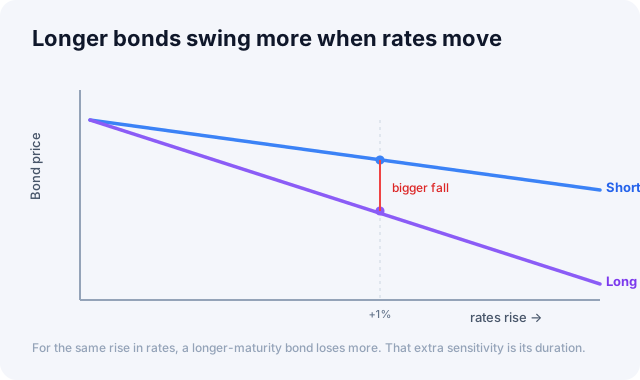
For the same rise in rates, a longer-maturity bond loses more. That extra sensitivity is its duration.
What duration measures
Duration is, roughly, how many percent a bond's price moves for a 1 percentage-point change in rates. A bond with a duration of 8 falls about 8% if rates rise 1%, and rises about 8% if they fall 1%. Longer maturities and lower coupons push duration higher.
💡 Tip: A quick rule of thumb is price change ≈ −duration × change in yield. Duration 10 and rates up 0.5% means roughly a 5% price drop.
| Maturity | Approx. duration | Price if rates rise 1% |
|---|---|---|
| 2-year | ~1.9 | about −2% |
| 10-year | ~8.5 | about −8% |
| 30-year | ~19 | about −19% |
Figures are rough and depend on the coupon, but the shape holds: the longer the bond, the bigger the swing.
Why the coupon changes duration
Two bonds can mature on the same day and still carry different duration. Duration is really the average time until you get your money back, weighted by how much comes back when. A high coupon returns more cash early, which pulls that average forward and shortens duration. A low coupon leaves most of the repayment sitting at the very end, so the bond's value rests on the distant future, and the distant future is exactly what a change in rates reprices hardest.
This is why a zero-coupon bond, which pays nothing until maturity, has the longest duration of all: with a single payment at the end, its duration is simply its maturity.
Convexity: the part duration gets wrong
Duration assumes the relationship between price and yield is a straight line, but it is actually a curve. That bend is called convexity, and it happens to work in the bondholder's favor. For a move of the same size, prices rise slightly more when yields fall than they drop when yields rise.
The practical consequence is that duration is a good approximation for small moves and understates the picture for large ones. If rates fall 3%, a long bond gains a bit more than duration alone predicts; if rates rise 3%, it loses a bit less. Convexity is a cushion, not a rescue, which is why the rule of thumb above should be read as an estimate rather than a formula.
Short versus long bonds
Longer bonds usually pay a bit more yield to compensate for that larger price risk. When you expect rates to fall, long duration is where the gains are; when you expect rates to rise, short duration protects your principal.
⚠️ Caution: A long-dated government bond is not automatically safe. Its credit risk is low, but its interest-rate risk is high, so it can drop sharply in a rising-rate year.
The 2022 episode is the cleanest illustration. Investors holding 30-year Treasuries were never at risk of not being repaid, and the US government paid every coupon on schedule. They still lost roughly a third of their market value, because rates rose fast and duration did exactly what it says it does. Credit risk and interest-rate risk are separate dangers, and a bond can be spotless on one while brutal on the other.
Managing duration in a portfolio
If you think rates are heading up, you can shorten duration by favoring shorter bonds or cash-like instruments. A bond ladder, holding bonds that mature in staggered years, spreads the risk and lets you reinvest as each rung matures. Matching duration to when you actually need the money is the core idea.
That last point is the one worth internalizing. If you need the money in three years, a 30-year bond is risky no matter how sound the issuer, because you may be forced to sell at whatever price prevailing rates leave you. Hold that same bond to maturity and the interim swings never touch you: the coupons arrive and the principal comes back. Duration risk is, in the end, the risk of having to sell early.
Bond funds and ETFs deserve a footnote here, because they never mature. A fund holding 20-year bonds keeps rolling into new ones, so its duration stays roughly constant and the price simply tracks rates. The "just hold to maturity" escape hatch does not exist there. That is not a flaw, but it does mean a bond ETF and an individual bond behave differently even when they hold the same paper.
What to watch
Duration risk lives and dies with the rate outlook, so track the US 10-year yield and the Fed's policy path. The Global Market Dashboard shows Treasury yields and the yield curve on one screen, a fast way to see whether rate pressure is building.
Further reading
For a thorough, plain-language treatment, Annette Thau's The Bond Book is a well-regarded reference on how bonds and duration work in practice.
Primary source: Bonds, SEC investor education
This article is for informational purposes only and is not investment advice.