"Is this stock cheap or expensive right now?" It's the first question that comes to mind when picking a stock. The share price itself, say $50 versus $500, is no basis for comparison. Instead we use valuation metrics that show where the price sits relative to a company's earnings, assets, and dividends. Here are the four most fundamental ones.
P/E (price-to-earnings ratio)
The P/E ratio divides share price by earnings per share, or EPS. It shows how many times a company's annual earnings the stock trades at. A P/E of 15 can be read intuitively as about 15 years to recover your money if current earnings hold steady.
A high P/E means the market expects strong future growth, or that the price is simply expensive relative to earnings. A low P/E could mean the stock is undervalued, but it's often a cheap-for-a-reason case reflecting stalled growth or risk.
The P/E is most meaningful within the same sector. Directly comparing the P/E of a high-growth tech stock with a mature bank isn't a fair comparison.
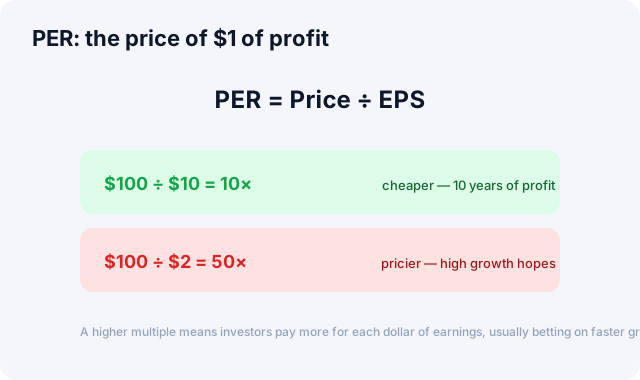
A higher multiple means investors pay more for each dollar of earnings, usually betting on faster growth.
P/B (price-to-book ratio)
The P/B ratio divides share price by book value per share, showing the price relative to the company's net assets, or equity. A P/B of 1 means the market cap equals book equity.
A P/B below 1 means the stock trades below book value, traditionally read as a value signal, though the assets in question may be low-quality or profitability weak. A company with a high P/B usually has a high return on equity, meaning it uses its assets efficiently, which is why P/B should be paired with ROE rather than read alone.
It's especially useful in asset-heavy sectors like banks, insurers, and manufacturers, and less informative for asset-light software and services firms.
PEG (P/E relative to growth)
The P/E's weakness is that it ignores growth. PEG corrects for this by dividing the P/E by the annual earnings growth rate, expressed as a percentage. A PEG around 1 is often seen as fair, and below 1 as cheap relative to growth. A fast grower can look reasonable on a PEG basis even with a high P/E. It relies heavily on the growth estimate, though, so the metric wobbles whenever that estimate turns out to be wrong.
Dividend yield
Dividend yield divides the annual dividend per share by the share price, showing how much you get back in dividends relative to the price. More mature, stable companies tend to yield more. An unusually high yield can be a warning sign, though. It may simply mean the price has crashed, sending the yield soaring, and a dividend the earnings can't support, meaning an excessive payout ratio, risks getting cut.
How to combine them
- Don't trust a single metric. You need P/E, P/B, growth, and debt together to form a full picture.
- Compare with peers and past averages. Relative position matters more than the absolute number.
- Check whether "cheap" has a reason. Distinguish whether a low P/E or P/B reflects undervaluation or structural weakness.
Indicators worth watching alongside
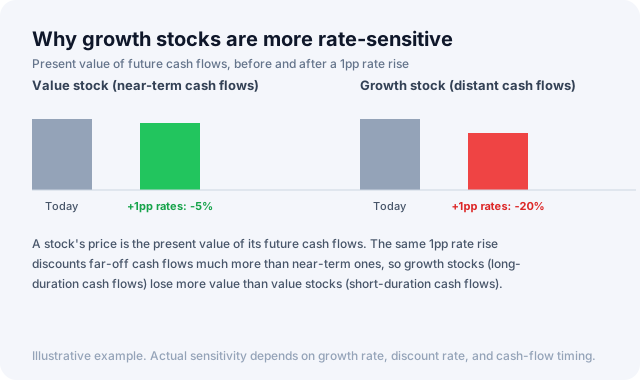
Valuation reads more richly alongside interest rates, which act as the discount rate, the earnings trend, and the sector cycle. When rates rise, the same P/E becomes more of a burden than it was before.
In the "Explore stocks" section of the Global Market Dashboard's stocks tab, you can see each stock's P/E, EPS, market cap, dividend, and financial trends together. Compare them for yourself.
Primary source: P/E ratio, SEC investor education
This article is for informational purposes only and is not investment advice.