Every so often the market has a stretch that feels alarming. Headlines turn red, a few big names drop several percent in a day, and the urge to "do something" gets loud. This guide is about that moment: what a volatile market actually is, what the evidence says about acting on fear, and how to separate real danger from noise.
First, is the whole market down, or just part of it?
The most common mistake in a scary week is reading a few dramatic names as the entire market. They are often not the same thing. A broad index can be nearly flat while one crowded corner falls hard, because money rotates out of the leaders and into other sectors rather than leaving stocks altogether.
So the first question is not "how do I feel" but "what is actually down." If the S&P 500 is off 1% while a single high-flying group is off 5%, that is a rotation inside the market, not a market-wide collapse. The fix is to look at the breadth, not the loudest ticker. A sector heatmap shows in seconds whether the pain is everywhere or concentrated.
Corrections are normal, not a malfunction
A drop of 10% from a recent high is called a correction, and historically the market has had one on average about once a year. A drop of 20% is a bear market, and those arrive every few years. These are not rare accidents; they are the price of admission for the higher long-run return stocks have paid over cash and bonds.
Framed that way, a correction is not evidence that something is broken. It is the ordinary behavior of an asset that rewards you for tolerating exactly this. An investor who is surprised by volatility has misunderstood the deal, not discovered a flaw in it.
Why selling in a panic is so costly
The strongest argument against acting on fear is arithmetic. The market's best days and worst days tend to cluster together, often within the same turbulent stretch, so an investor who sells to escape the bad days usually misses the sharp rebounds sitting right next to them.
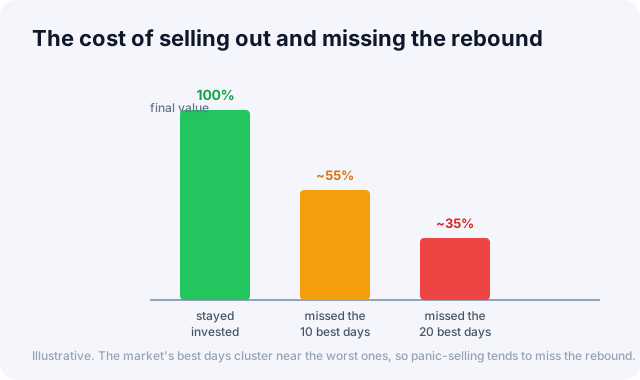
Illustrative. The market's best days cluster near the worst ones, so panic-selling tends to miss the rebound.
Missing only a handful of the strongest days over a long period has historically cut the final result dramatically, because those days do the heavy lifting of the whole return. And they are unpredictable by design: they often land in the middle of the scariest headlines, exactly when a frightened seller is on the sidelines waiting to feel safe again.
⚠️ Caution: "I'll get back in when things calm down" sounds prudent and rarely works. By the time it feels safe, the rebound has usually already happened. Selling low and buying back higher is how a temporary drop becomes a permanent loss.
What you can reasonably do
Not doing something is a strategy, but it is not the only one. There are calm, non-panicked actions that are genuinely reasonable in a downturn.
| Usually a mistake | Usually reasonable |
|---|---|
| Selling everything to "wait it out" | Continuing scheduled contributions |
| Trying to time the exact bottom | Rebalancing back to your target mix |
| Doubling down on the one thing falling | Checking your emergency cash is intact |
| Checking the portfolio hourly | Reviewing whether your plan still fits |
Continuing to invest on schedule through the drop, covered in the guide on dollar-cost averaging, quietly buys more when prices are lower. Rebalancing, selling a little of what held up to buy a little of what fell, is a rules-based way to "buy low" without predicting anything.
Decide the rules before you need them
The reason volatility is dangerous is not the volatility itself; it is that decisions made while afraid are usually bad ones. The defense is to make the important decisions in advance, when you are calm, and then follow them.
💡 Tip: Write down, before the next drop, how much loss you can hold without selling, and let that set your mix of stocks to safer assets. A plan you chose in daylight beats an instinct you follow in the dark.
If a 20% fall would force you to sell, your allocation was too aggressive for you, and the lesson is to adjust the plan afterward, in calm, not to abandon it mid-storm. The single most valuable trait in a volatile market is having decided what you will do before the market asks.
What to watch
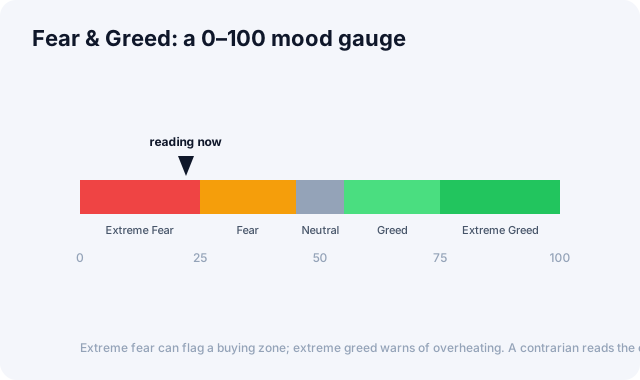
Sentiment tools help you see whether fear is spreading or already extreme, and extreme fear has historically been closer to a bottom than a top. The Global Market Dashboard shows the VIX and the Fear & Greed Index on one screen, and the market-conditions gauge reads the macro backdrop so you can tell a mood swing from a genuine change in the weather.
Further reading
For a calm, evidence-based perspective on riding out volatility, Morgan Housel's The Psychology of Money is a short and widely recommended read on how behavior, not brilliance, drives most investing outcomes.
Primary source: What is risk, SEC investor education
This article is for informational purposes only and is not investment advice.