"I checked the company's financials" is something you hear often before someone buys a stock. Open an actual filing, though, and you're met with three dense tables of numbers. Once you know what each one is actually answering, you can pull out a surprising amount of information in just a few minutes.
Why there are three separate statements
Financial statements are built to answer three different questions about a company. "Did this company make money?" is answered by the income statement. "What does it own and owe right now?" is answered by the balance sheet. "It says there's a profit, but is there actual cash?" is answered by the cash flow statement. Looking at only one of the three shows you only part of the picture.
Income statement: did the company make money?
The income statement covers a specific period (a quarter or a year) and shows revenue minus expenses. Subtract cost of goods sold from revenue and you get gross profit; subtract operating expenses from that and you get operating income; account for interest and taxes and what's left is net income, the number usually reported as "earnings" in the news.
Balance sheet: what does it own right now?
Unlike the income statement, the balance sheet is a snapshot at a single point in time. One side lists what the company owns (assets); the other lists how those assets were financed (liabilities plus equity), and the two always match exactly. This is where you see how much cash, inventory, or equipment a company holds, and how much of it was bought with borrowed money.
Cash flow statement: profit and cash aren't the same thing
The cash flow statement tracks only the actual cash that moved in and out. It exists because a profit on the income statement doesn't automatically mean that much cash landed in the company's bank account. Book a sale on credit, for example, and it shows up as profit on the income statement even though the cash hasn't arrived yet.
⚠️ Note: Companies really do go under while reporting a profit, simply because they run out of cash. That's exactly why judging a company as healthy from net income alone is risky. If operating cash flow is consistently lower than net income, or negative, that's worth a closer look.
How the three statements connect
The three statements aren't independent tables. Net income from the income statement flows into retained earnings on the balance sheet, and the cash flow statement starts from that same net income figure and works backward to the actual change in cash.
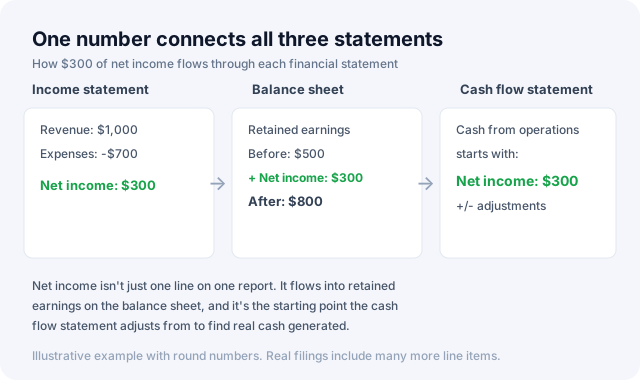
Illustrative example. Real filings include many more line items.
The three statements side by side
| Statement | What it shows | Period | Key question |
|---|---|---|---|
| Income statement | Revenue minus expenses | A period (quarter/year) | Did it make money? |
| Balance sheet | Assets, liabilities, and equity | A point in time (snapshot) | What does it own and owe right now? |
| Cash flow statement | Actual cash in and out | A period (quarter/year) | Is there cash to match the profit? |
💡 Tip: If this is your first time, don't try to master all three statements at once. Start with just three numbers from the income statement (revenue, operating income, net income), cash and debt levels from the balance sheet, and operating cash flow from the cash flow statement.
Putting it to work
Most of the numbers you hear during earnings season come straight from these three statements. Valuation metrics like P/E and P/B ratios pull directly from net income on the income statement and equity on the balance sheet. When looking at dividends, as covered in dividend investing basics, you need both earnings and cash flow to judge whether a payout is sustainable. Where financial statements look at a company's fundamentals, technical analysis basics takes a completely different approach, reading price and volume instead. The two aren't mutually exclusive; they're often used together.
Further reading
Thomas Ittelson's Financial Statements: A Step-by-Step Guide to Understanding and Creating Financial Reports is a consistently recommended, ground-up explanation of how the statements work.
Primary source: Beginners' Guide to Financial Statements, U.S. SEC (Investor.gov)
This article is for informational purposes only and is not investment advice.