If Bitcoin is often compared to digital gold, Ethereum is usually compared to a world computer. Both are blockchains, but they were built for different purposes, and that difference shapes everything from their supply mechanics to the ecosystems built on top of them.
What Ethereum is: a smart contract platform
Ethereum was designed to do more than move value around. It runs smart contracts: programs stored on the blockchain that execute automatically once their conditions are met. Smart contracts let lending, trading, and asset issuance happen without a middleman, handled entirely by code. The ecosystem that grew out of this capability is known as DeFi, short for decentralized finance.
Ethereum's supply structure: no fixed issuance schedule
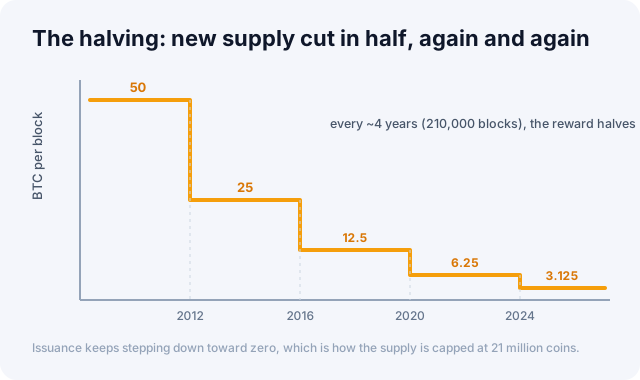
Bitcoin's halving follows a predictable schedule, cutting new issuance in half every four years. Ethereum works differently. New ETH is issued continuously to validators, but a base fee is burned on every single transaction (a mechanism called EIP-1559). Net supply change is therefore issuance minus burn, and depending on network usage that number can turn positive (inflationary) or negative (deflationary).
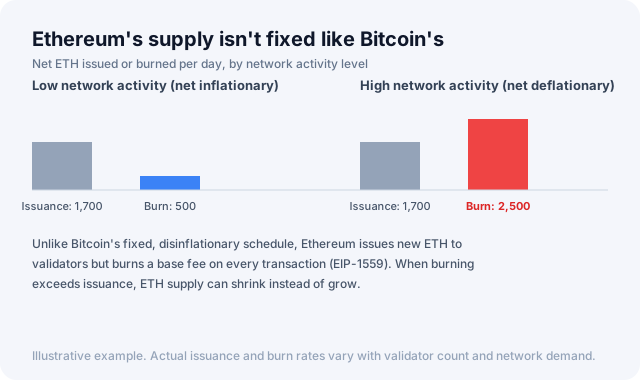
Illustrative example. Actual issuance and burn rates vary with validator count and network demand.
💡 Tip: Ethereum's supply doesn't follow the same "fixed total, scarce asset" story as Bitcoin's. The more the network is actually used, the more supply tends to shrink, which ties on-chain activity directly to the supply itself.
What DeFi is
DeFi refers to financial services that run purely on smart contracts, without a bank or other intermediary in the middle. The most common activities are:
- Lending and borrowing: depositing an asset to earn interest, or posting collateral to borrow a different asset
- Decentralized exchanges (DEXs): trading venues where smart contracts, not a central operator, match and settle trades
- Staking: delegating an asset to help secure the network in exchange for rewards
Total value locked (TVL), the total assets deposited across a protocol or the whole DeFi ecosystem, is a commonly used gauge of scale.
DeFi's core risk: collateral ratios and liquidation
Most DeFi lending is overcollateralized: to borrow $100, you might need to post $150 worth of collateral. If the collateral's price falls and the collateral ratio drops below a set threshold, the smart contract automatically sells the collateral to repay the loan, a process called liquidation.
⚠️ Note: Liquidation is triggered by code detecting a condition, not by a human decision. During sharp crypto price drops, a wave of liquidations can hit in a short window and add further downward pressure on prices.
Comparing DeFi activities
| Activity | Main risk | Where the return comes from |
|---|---|---|
| Lending (depositing) | Collateral value drop, smart contract bugs | Interest paid by borrowers |
| Borrowing against collateral | Liquidation risk | Deploying the borrowed asset elsewhere |
| DEX liquidity provision | Impermanent loss | Trading fees |
| Staking | Lockup periods, slashing (a penalty for violations) | Network validation rewards |
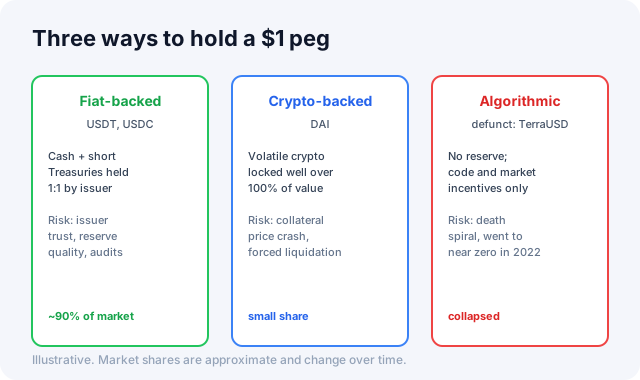
DeFi is also an ecosystem where stablecoins are widely used as the base currency for lending and trading. Since stablecoins are so often used as collateral or the borrowed asset itself, the stability of a stablecoin's peg becomes a risk factor for DeFi more broadly.
Where to look
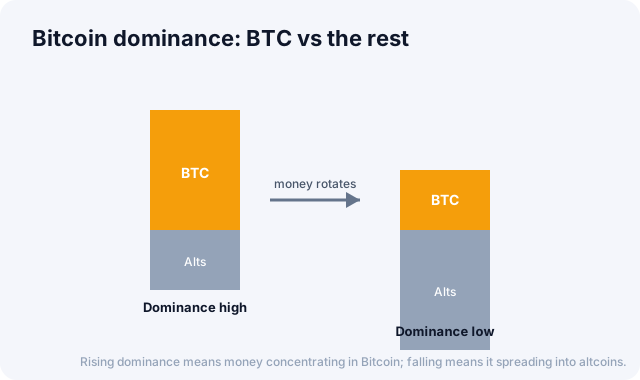
The dashboard tracks the market cap of Ethereum and other major cryptocurrencies alongside crypto market cap dominance. For a deeper look at on-chain activity, the concepts covered in Bitcoin on-chain indicators apply similarly to Ethereum analysis. For the wider picture, see Getting Started with Global Markets.
Further reading
Camila Russo's The Infinite Machine is a widely read account of Ethereum's founding and early history.
Primary source: EIP-1559 and Ethereum's issuance model, ethereum.org official documentation
This article is for informational purposes only and is not investment advice.