Watching individual coin prices alone makes it easy to miss the big picture in crypto. The single fact that Bitcoin is up 5% doesn't tell you whether money is flowing into the market or whether cash that left other coins simply piled into Bitcoin instead. Look at market cap and Bitcoin dominance together, and you can read whether capital is entering or leaving the whole market, and whether it's heading into Bitcoin or into altcoins.
What market cap is
Market cap is coin price multiplied by circulating supply. It measures the size of a single coin and of the whole crypto market.
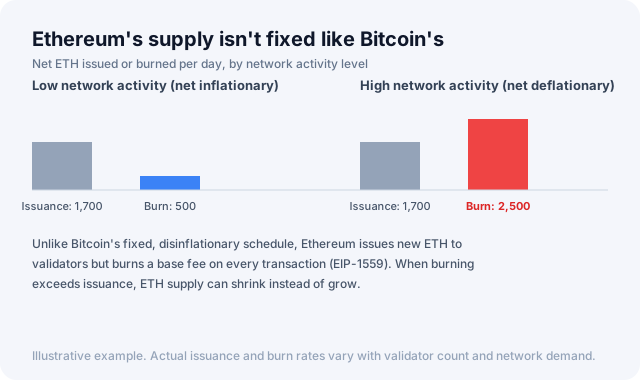
When total market cap rises, money is flowing into the market overall; when it falls, money is leaving. Price alone can be misleading here. A coin whose supply is inflating fast can grow its market cap even if the price is flat, while a coin that burns tokens can have a sluggish cap even as its price rises.
A frequently confused concept is fully diluted valuation, or FDV. Unlike market cap, which is based on current circulating supply, FDV includes all tokens that will be released in the future. If FDV runs far larger than market cap, a lot of supply, meaning selling pressure, is still to come, so it's worth checking whenever you evaluate a new coin.
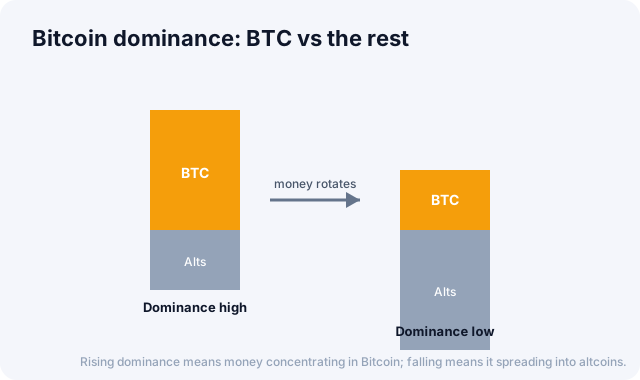
Rising dominance means money concentrating in Bitcoin; falling means it spreading into altcoins.
What Bitcoin dominance is
Bitcoin dominance is the ratio of Bitcoin's market cap to total crypto market cap. It shows Bitcoin's share of the whole market.
When dominance rises, money is concentrating relatively into Bitcoin, whether from a flight to safety or a BTC-led rally. When dominance falls, money is spreading out into altcoins instead, a sign of risk appetite.
Within crypto, Bitcoin sits at the safer end of the spectrum. So BTC dominance reads like a risk-appetite gauge internal to the crypto market, roughly analogous to capital rotating between large-cap blue chips and small-cap growth stocks in equities.
Reading the regime with dominance
Combining total market cap and dominance, you can split the market into roughly four regimes.
| Total cap | Dominance | Regime |
|---|---|---|
| ↑ | ↑ | Bitcoin-led bull. New money flows mainly into BTC |
| ↑ | ↓ | Money spreading into altcoins, so-called alt season |
| ↓ | ↑ | Risk-off. Money flees from alts into BTC |
| ↓ | ↓ | Broad bear. Alts fall harder than BTC |
A commonly observed cycle looks like this: early in a bull run, money enters Bitcoin first and dominance rises, which is regime one. After BTC has run for a while, profits spill over into alts and dominance falls, regime two. Then as the market cools, money flees back to BTC, regime three. This is only a tendency, though, and it doesn't repeat in the same order every time.
Stablecoin market cap too
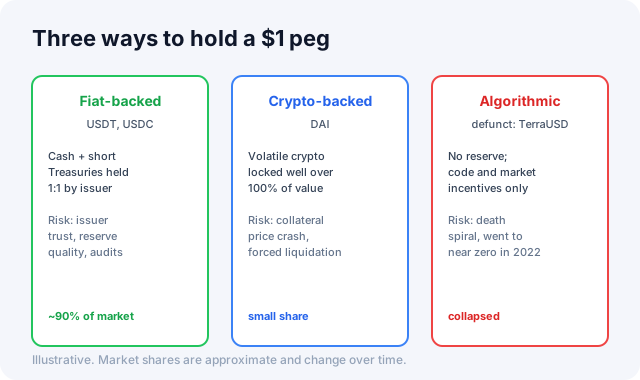
Another useful gauge is total stablecoin market cap, covering coins like USDT and USDC. Stablecoins function close to dry powder, cash sitting ready to buy at any time.
When stablecoin cap grows, ready cash is building up on the sidelines, a sign of potential buying power. When stablecoins get rotated rapidly into other coins, it can signal that dry powder is turning into actual buying.
What altcoin season means, and its limits
When dominance drops and altcoins outpace Bitcoin, people call it alt season. This is a description after the fact, though, not a forecast. Altcoins carry far more volatility and risk, and low-liquidity coins tend to crash even harder after spiking. A falling dominance is not a signal to buy alts. In fact, the late stage of a dominance decline often signals an overheated market, so read it together with the Fear & Greed Index and risk management.
FAQ
Q. If dominance rises, should I buy Bitcoin? No. Dominance is a share, not a price. Even in a bear market with falling total cap, dominance can rise if alts fall more, which is regime three above. Always interpret it alongside total market cap.
Q. How are stablecoins handled in the dominance calculation? It varies by source. Some versions include stablecoins in dominance, others exclude them, so the number can differ at the same moment depending on which basis you're looking at.
Q. Does altcoin season arrive on a schedule? No. It's been observed a few times historically, but the timing and intensity aren't fixed, and as market structure changes, past patterns may not repeat. Betting on it like a guaranteed season is risky.
How to read it
- Use market cap, not price. Changes in market size read accurately through cap, not the sticker price of any one coin.
- Read total cap and dominance together. Combining them is the only way to see the direction of flows across the four regimes.
- Add stablecoins and sentiment. Bringing in dry powder and the Fear & Greed Index helps gauge overheated versus fearful phases.
Indicators worth watching alongside
Dominance gets richer when read with total market cap, the crypto Fear & Greed Index, and on-chain indicators. The Global Market Dashboard shows crypto market cap and dominance alongside the Fear & Greed Index and on-chain indicators on one screen. To see where crypto sits in the whole market, start with Getting Started with Global Markets.
This article is for informational purposes only and is not investment advice.