If you have shopped for a U.S. stock ETF, you may have noticed some tickers ending in (H) and others without it, both tracking the exact same S&P 500. Why do both exist? Here is what currency hedging actually removes, what it costs you in exchange, and why that cost is not arbitrary but comes straight out of the interest rate gap between two currencies.
What currency hedging is
Investing in a foreign asset gives you returns from two sources: the price move of the asset itself, and the move in the exchange rate of the currency it is priced in. If U.S. stocks rise 10% but the won strengthens against the dollar over the same period (USD/KRW falls), your won-denominated return shrinks; if the won weakens instead, it grows. Currency hedging uses instruments like forward contracts or currency swaps to strip out that second factor, the exchange-rate move. Once hedged, your return reflects only the asset's price move, largely independent of where the exchange rate goes.
A ticker ending in (H) is hedged; (UH), or no suffix at all, is unhedged, meaning you carry the full currency exposure.
Hedging is not free
Here is where the common misconception creeps in: it is easy to assume "hedged = the safe, risk-free choice." In reality, hedging carries a cost, or occasionally a benefit, and its size is set by the interest rate gap between the two currencies involved.
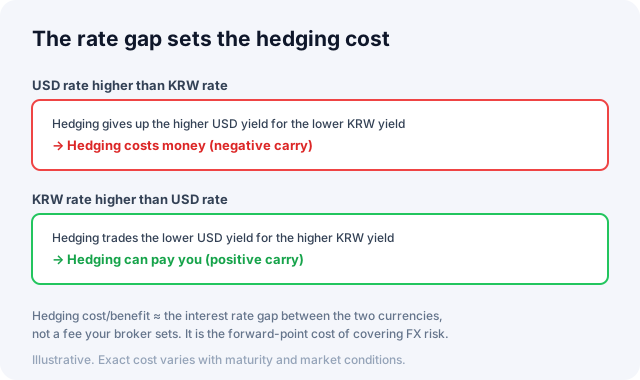
Illustrative. The actual cost varies with maturity and market conditions.
The mechanism works like this. Currency hedging runs through forward contracts, and the forward exchange rate is set by adjusting the spot rate for the interest rate gap between the two currencies. When U.S. rates sit above Korean rates, hedging means giving up the higher-yielding dollar side for the lower-yielding won side, and that gap becomes your cost. When Korean rates sit above U.S. rates instead, hedging can actually pay you that same gap as a benefit, known as positive carry.
As of July 2026, the U.S. Federal Reserve's policy rate sits around 3.6%, while the Bank of Korea just raised its base rate to 2.75%, its first hike in three and a half years, narrowing the gap to roughly one percentage point. Because a wider rate gap tends to mean a costlier hedge, how that gap widens or narrows over time directly shapes how a hedged fund performs relative to its unhedged twin.
⚠️ Note: The hedging cost is separate from the fund's management fee. The fee is visible up front, but the hedging cost gets shaved off gradually through the forward market and simply shows up as lower returns. Judging a hedged product as "cheap" purely by its stated expense ratio can miss its real drag.
When to choose hedged versus unhedged
There is no single right answer, but there are some useful rules of thumb.
| Situation | Better fit | Why |
|---|---|---|
| You expect the won to weaken (dollar to strengthen) | Unhedged | The currency move becomes additional upside |
| You expect the won to strengthen | Hedged | Protects against the currency move eating into returns |
| You are unsure of direction, want pure asset exposure | Hedged | Strips out the currency variable, leaving just the price move |
| U.S. rates sit well above Korean rates | Lean unhedged | This is exactly when hedging costs the most |
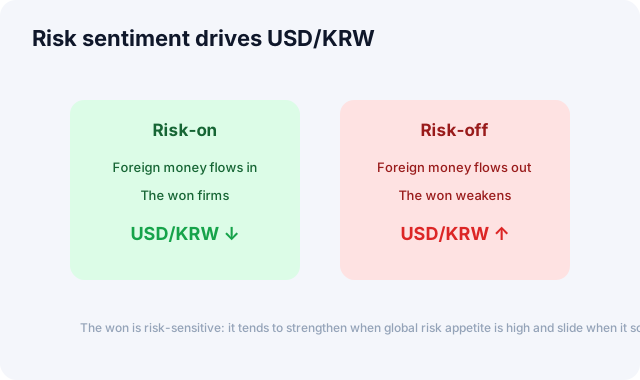
One detail that is easy to miss: the dollar tends to strengthen during risk-off periods, so during a sharp stock selloff, an unhedged position can see the currency gain partly offset the price decline. A hedged position loses that cushion entirely, so a downturn shows up in full in won terms.
Hedging matters even more for bonds
For stocks, expected returns are large enough that the hedging cost tends to feel like a smaller slice of the total picture. Bonds are different. If a U.S. Treasury yields 4-5% and the hedging cost runs 2 percentage points or more, what you actually pocket after hedging shrinks dramatically. That is why the hedge decision has a much more direct impact on returns for foreign bond investing than it does for stocks.
How to read it
- Hedging cost is a shadow of the rate gap. Watch whether the gap between the Fed and the Bank of Korea's policy rate is widening or narrowing.
- Scrutinize the hedge decision especially closely for bonds. The hedging cost is a much larger share of the coupon, so it swings the outcome more.
- Remember the cushioning effect of staying unhedged during a crisis. Since dollar strength often accompanies risk-off moves, unhedged foreign assets can act as a partial buffer in a downturn.
What to watch
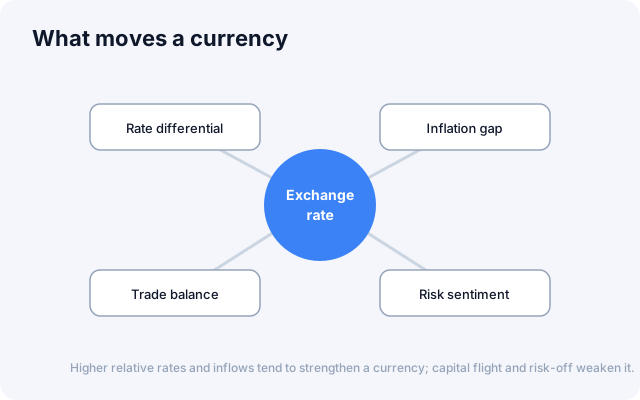
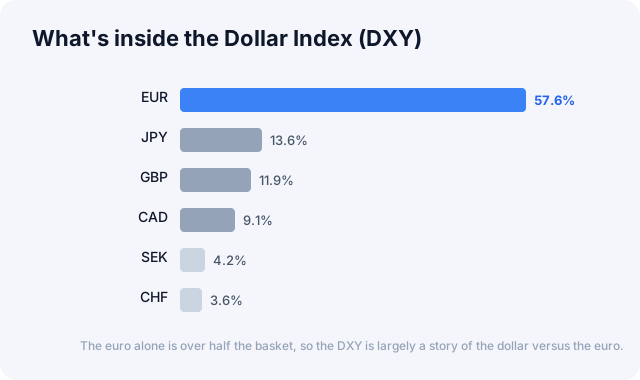
The dashboard shows the Dollar Index (DXY), the USD/KRW exchange rate, and what drives exchange rates together. Tracking the rate gap alongside the exchange rate trend helps gauge whether now is a favorable moment to hedge.
Primary source: Foreign Exchange Market and Rates, Bank of Korea
This article is for informational purposes only and is not investment advice.