In a market where Bitcoin can swing more than 5% in a day, one category of coin is built to always sit near one dollar. That is a stablecoin. Given how volatile crypto is, why does it need a "stable" coin at all, what actually backs that stability, and what happens when a coin everyone trusted to be stable turns out not to be? Here is how to think through each question.
What a stablecoin is
A stablecoin is a cryptocurrency designed to hold its price pegged to a fiat currency, almost always the U.S. dollar. One USDT or one USDC is meant to always equal one dollar. The point is simple: it lets you sit in a volatile-free asset or trade between coins on an exchange without withdrawing to a bank account and wiring money back in every time.
As of mid-2026 the total stablecoin market is worth roughly $300 billion, with USDT (Tether) holding about 60% and USDC (Circle) about 24%, so the two together make up close to 90% of the market.
Three ways to hold the peg
How each coin keeps its "always one dollar" promise differs, and that design choice is exactly what determines how much risk you are taking.
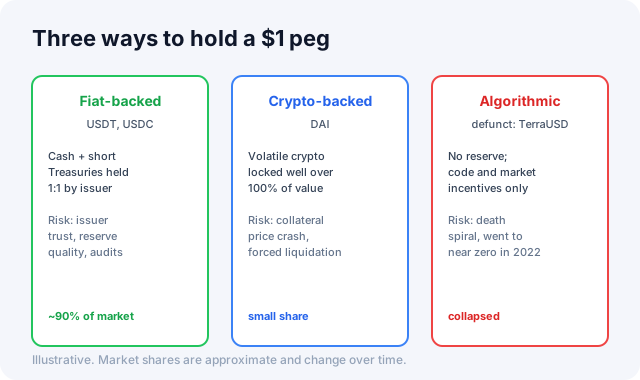
Illustrative. Market shares are approximate and change over time.
Fiat-backed coins (USDT, USDC) hold cash and short-term Treasuries roughly equal to the coins in circulation. This is the simplest design and dominates the market today. The risk comes down to whether you trust the issuer, whether the reserves genuinely exist in that amount, and how safe those reserve assets actually are.
Crypto-backed coins (like DAI) lock up volatile assets such as Bitcoin or Ether worth well more than the coin issued, often 150% or more, to support the peg. They need less trust in a single issuer, but a sharp drop in the collateral's price can trigger forced liquidations.
Algorithmic stablecoins try to hold the peg using code and market incentives alone, with no reserve backing it. The idea sounded elegant, but in 2022 TerraUSD (UST) collapsed using exactly this design, and the category has been essentially shut out of the market since.
When the peg breaks: two real cases
⚠️ Note: The word "stable" is not a guarantee. In May 2022, the algorithmic stablecoin TerraUSD (UST) was designed to support its peg through a sister token, LUNA. When large-scale selling began, that same mechanism accelerated the collapse instead of preventing it. Within days UST fell from one dollar to effectively zero, and tens of billions of dollars vanished, in what became known as the "death spiral."
Fiat-backed coins are not risk-free either. In March 2023, USDC issuer Circle had part of its reserves parked at Silicon Valley Bank. When SVB failed, USDC briefly dropped to $0.87. It recovered to a dollar within days once the U.S. government guaranteed all SVB deposits, but the episode was a clear demonstration of why "do the reserves genuinely exist and remain accessible" is the question that matters most.
The GENIUS Act: the first federal framework
Stablecoins grew for years without a clear federal rulebook in the U.S. The GENIUS Act (Guiding and Establishing National Innovation for U.S. Stablecoins Act), enacted in July 2025, created the country's first comprehensive federal regulatory framework for payment stablecoins.
Its core requirements:
| Area | Requirement |
|---|---|
| Reserves | Held 1:1 in cash and short-term Treasuries or similarly liquid assets |
| Redemption | A defined process to redeem coins on request |
| Capital & risk management | Minimum capital and risk-management standards for issuers |
| Disclosure | Regular public disclosure of reserve composition |
As of 2026, the OCC, FDIC, and Treasury's FinCEN are each in the proposed-rule stage of implementation, and the law takes full effect no later than January 2027. A regulatory framework does not eliminate risk, but it puts a baseline safeguard in place against reserve shortfalls or refused redemptions.
What stablecoins are actually used for
The most common use is simply parking funds on an exchange: sell a coin, hold the proceeds in USDT or USDC instead of cashing out, then buy something else later. Beyond that, stablecoins are used for DeFi lending and deposits, cross-border remittances, and as a dollar-substitute savings tool in countries with volatile local currencies. As covered in crypto market cap and dominance, a rising stablecoin market cap is often read as a sign of sidelined cash building up, ready to be deployed.
What holders should know
💡 Tip: A stablecoin is not a bank deposit. Deposit insurance (FDIC in the U.S.) does not apply to the coin itself, and if the issuer fails or its reserves take a loss, redemption can be delayed or a loss can occur. Rather than parking a large sum in stablecoins for a long stretch across several exchanges, it is safer to hold only what you need for a short window.
The risk breaks down into three questions: does the issuer genuinely and safely hold reserves equal to what is in circulation (issuer risk); can those reserves be accessed if there is a problem in the banking system (the SVB case); and is the peg backed by real reserves at all, or is it being held together by code alone (the Terra case)?
What to watch
The dashboard shows crypto market cap alongside Bitcoin dominance and the Fear & Greed Index. A stablecoin's own price should stay boringly close to one dollar at all times, which means the moment it drifts off that peg is itself a signal of stress somewhere in the system.
Further reading
Zeke Faux's Number Go Up traces how Tether grew and the doubts that have followed it, offering a journalist's ground-level look at how a stablecoin actually operates in practice.
Primary source: FDIC, Approves Proposal to Implement GENIUS Act Requirements and Standards
This article is for informational purposes only and is not investment advice.