Roughly every four years, the number of new bitcoins created per block is cut in half. It is written into the code, everyone knows the date in advance, and yet it remains the single most discussed event in crypto. Here is what it actually does, and what it does not.
What the halving is
New bitcoins enter circulation as a reward paid to whoever mines a block. That reward started at 50 BTC and is programmed to halve every 210,000 blocks, which works out to roughly four years. The halving is not a decision anyone makes; it is a rule in the protocol.
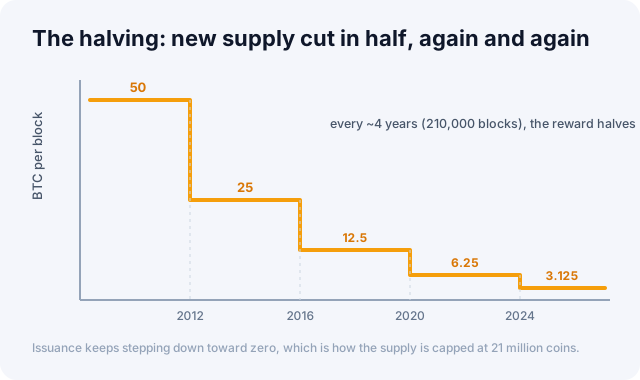
Issuance keeps stepping down toward zero, which is how the supply is capped at 21 million coins.
Why it matters: the supply side
A halving instantly cuts the rate of new supply in half. Miners, who are structural sellers because they must pay electricity bills in regular money, suddenly have half as much to sell. If demand simply stays flat, less new supply hitting the market is a tightening force.
| Halving | Block reward |
|---|---|
| 2012 | 50 → 25 BTC |
| 2016 | 25 → 12.5 BTC |
| 2020 | 12.5 → 6.25 BTC |
| 2024 | 6.25 → 3.125 BTC |
💡 Tip: The halving is about the flow of new coins, not the stock of existing ones. Almost 20 million bitcoin already exist and can be sold at any time, so the halving nudges the margin rather than flipping a switch.
That tip deserves the arithmetic behind it. New issuance is a small stream next to the ocean of coins already outstanding, and daily trading volume dwarfs both. Halving a small stream halves a small stream. It is a real change at the margin, not a sudden shortage.
What it does to miners
The group the halving hits immediately and unambiguously is miners. Their revenue per block is cut in half overnight while their electricity bill is not, so the least efficient operations become unprofitable and shut down.
When miners drop off, the network's total computing power falls, and Bitcoin responds with a difficulty adjustment: roughly every two weeks it recalibrates how hard the puzzle is, so blocks keep arriving about every ten minutes regardless of how many miners remain. This is the mechanism that keeps the schedule honest. The survivors then earn a larger share of a smaller reward, and the system settles.
So each halving quietly reshapes the mining industry: it pushes the business toward cheaper electricity and newer machines, and it makes transaction fees a slowly growing share of miner income. That last point matters for the distant future, since issuance eventually goes to zero and fees are what will pay for security.
What history actually shows
Each of the past halvings was followed, over the following year or so, by a large run-up. That is the argument you will hear most often. It is also worth being honest about the evidence.
⚠️ Caution: There are only four halvings in history. Four data points is a story, not a law. Those cycles also coincided with cheap money, new access through exchanges and ETFs, and waves of retail attention, so untangling the halving from everything else is close to impossible.
The stock-to-flow argument, and why it is contested
The most popular framework built on the halving is stock-to-flow: divide the existing supply by annual new issuance, and you get a scarcity ratio that jumps at every halving. Because that ratio rose alongside price historically, the model was read as predictive, and it produced confident price targets.
The criticism is straightforward. A model fitted to four events, on a series that trended up for unrelated reasons, will look excellent in hindsight and prove very little. Scarcity is only half of a price: something can be perfectly scarce and worth nothing if nobody wants it. Treating a supply schedule everyone can read as a forecast confuses an input with an outcome.
What actually drives the price
Everyone can read the schedule, which means markets have had years to price it in. In an even moderately efficient market, a known future event does not wait until the day to be reflected. In practice, demand has been the swing factor: regulation, access, liquidity conditions, and how much attention the asset is getting. The halving tightens the supply screw a little; demand decides whether that matters this time.
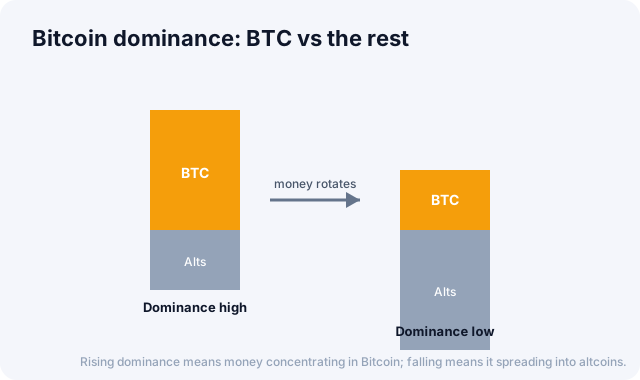
Watch Bitcoin dominance to see whether money is concentrating in BTC, and the on-chain indicators for whether price has run hot relative to network value.
What to watch
Crypto cycles are driven as much by mood as by math, so read the schedule alongside sentiment. The Global Market Dashboard shows the Crypto Fear & Greed Index, dominance, and total market cap on one screen.
Further reading
For the monetary reasoning behind a fixed supply, Saifedean Ammous's The Bitcoin Standard lays out the case, though it argues a strong point of view rather than a neutral one.
This article is for informational purposes only and is not investment advice.